
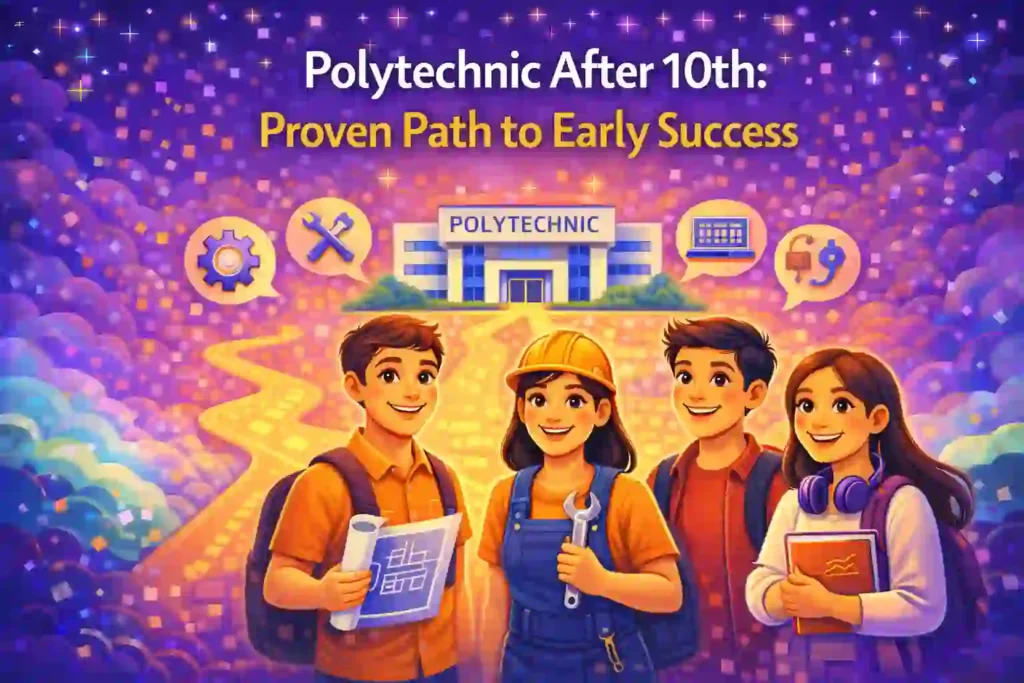
Polytechnic after 10th stands out as one of the best choices for a great career in tech. Most students go to 11th grade. But smart minds across India pick a new path. They go for diploma courses. These courses give them real skills. In just three years, they become job-ready. This path has changed many lives. Young men and women now earn well and build steady careers.
The best part of polytechnic after 10th? It focuses on hands-on work. Most schools teach from books. But polytechnic trains you with real tools.
You learn by doing, as you work with actual machines. You use gear that the job market needs. When you finish, you are not just a paper holder. You can work from day one.
This guide will help you know all about polytechnic after 10th. You will learn about how to get in, the best schools, top branches, fee plans, job scope, and pay scales. Are you a student looking at options? Or a parent doing research? This post will answer your questions. It will help you make a wise choice.
Polytechnic After 10th: Easy choice of Students
More students now choose polytechnic. This shift has good reasons. Parents and kids see the clear gains that come with diploma courses. Let us look at why this trend keeps growing.
You start your career early. This tops the list of gains. Your friends will still be in 12th when you finish your diploma. When they get their degree, you will have three years of job time. This head start helps a lot. You earn more over your life. You grow faster in your field.
The money side makes sense too. Polytechnic fees cost much less than B.Tech fees. State run schools charge just Rs 5,000 to Rs 25,000 per year. Even private ones cost less than most degree programs. You save cash while gaining skills that get you hired fast.
Hands-on training sets polytechnic apart from other paths. The course plan puts weight on lab work, shop floor time, and real job training. You spend more time doing than reading books. This makes you job ready the day you get your diploma.
The lateral entry route gives you more choices. When you finish your diploma, you can skip to second year B.Tech. So you can still get a full degree if you want. You get both worlds. You have hands-on skills plus the choice to study more later.
Polytechnic After 10th: Admission Steps for 2026
To get a seat in a good school, you must know the steps. Each state has its own test and process. Here is a clear list of what to expect.
Who Can Apply for Polytechnic After 10th?
The main rule is simple. You must pass 10th from a known board. Most states ask for at least 35% marks. Top schools may want more. You should have Math and Science as main subjects. Age limits vary by state. Most allow ages 14 to 25.
State Polytechnic Entrance Exams
Each state runs its own test. UP has JEECUP. Delhi has CET. Karnataka runs DCET. Maharashtra has PAT. Rajasthan runs RPET. These tests happen from April to June each year. The test covers 10th level Math and Science.
Sign up starts in March or April. Fill the form online. Pay the test fee. Keep your 10th marks sheet ready. Have your ID proof. Get some photos. The fee runs from Rs 300 to Rs 600 based on your group and state.
How Seats Get Allotted for Polytechnic After 10th?
When results come out, the next step begins. You pick schools and branches you like. Seats go out based on your rank. They also check what you picked and what is free. Many rounds run to help most students get in. Bring your papers for checking.
Polytechnic After 10th: Best Colleges in India for 2026
India has, without a doubt, great polytechnic schools in every state. The right school can, in fact, shape your learning and job future. Here are some of the top ones you should look at.
Government Polytechnic Mumbai ranks, for instance, among the oldest tech schools in the land. It gives, as a result, good training with skilled teachers. The campus has great tools, and because of this, job drives bring in big firms. Fees stay low since the state runs it.
Pusa Polytechnic Delhi draws, for example, students from all of North India. It sits in the heart of the capital, which means you get to see the big job hub of Delhi-NCR. The school has strong ties with firms, and as a result, this helps you get internships and jobs. Past students, even now, stay in touch and help.
Government Polytechnic Pune has, over the years, built a strong name. The school pushes hard on studies and hands on training, and because of this, students gain from Pune’s growing IT and making sectors. Many past students, as a matter of fact, now work at top firms.
Thiagarajar Polytechnic Madurai in Tamil Nadu is, without question, another top school. It runs many branches with new labs and shops, so naturally, the teaching style builds strong basics along with real skills. South Indian firms, for this reason, hire a lot from here.
Government Polytechnic Lucknow serves, each year, many students in UP. It keeps putting out skilled workers and junior engineers, and thanks to new gear and tools that came in recently, students from here get placed in both state and private jobs.
Polytechnic After 10th: Top Diploma in Engineering Branches
Picking the right branch matters a lot because it sets your job path. Each branch has, after all, its own job types, pay range, and growth scope. Let us look at the top picks for students going for polytechnic after 10th.
Diploma in Mechanical
Mechanical stays, year after year, the top pick among diploma students. This field covers cars, making things, heat systems, and factory gear, which is why jobs exist in almost every field. Every sector needs, as you can see, mechanical know-how. New hires get Rs 15,000 to Rs 25,000 monthly, while seniors earn much more.
Diploma in Electrical
Electrical opens, first and foremost, doors to power sector jobs. You learn about making power, sending it, and fixing gear, and for this reason, state jobs in power boards draw many diploma holders. Green energy is, at the same time, making new jobs for electrical diploma grads.
Diploma in Civil
Civil diploma holders help, in many ways, build India. Builders, state offices, and real estate firms always need, as you might expect, civil techs. You can work as a site head, survey man, or junior engineer, and thanks to India’s push to build more roads and bridges, demand stays high.
Diploma in Computer Science and IT
Computer Science fits, in particular, those who love tech and coding. You learn coding, networks, data, and web making, which is why IT firms hire diploma holders for support, testing, and coding roles. The digital wave across all fields has, as a result, raised demand.
Diploma in Electronics
Electronics covers, among other things, phones, smart chips, and gadgets. Telecom firms, device makers, and robot firms hire, for the most part, from this branch. IoT and smart tech are, at this very moment, making new job paths. This branch, on top of that, also works well if you want to start your own shop.
Polytechnic Fees Guide 2026
Low cost is, without a doubt, a key gain of polytechnic study. Fees change a lot between state and private schools, and for this reason, knowing the costs will help you plan your money better.
State polytechnics charge, as you would expect, very low fees. Yearly fees run from Rs 5,000 to Rs 25,000 based on state and course, while extra costs include hostel, exam, and library fees. SC/ST students often get fee cuts, and in addition to that, many states give money help that covers most school costs.
Private polytechnics charge more but may, in return, give better tools. Yearly fees can run from Rs 30,000 to Rs 80,000 based on name and gear, and some top private ones charge even more. They may, on the other hand, help more with job drives. Think about what you get back when you look at private school fees.
Many ways exist, in fact, to get money help. The state portal offers many plans for tech students, and at the same time, state govts run their own grant programs. Banks give study loans at fair rates for diploma courses, so do not let money worries stop you from pursuing polytechnic after 10th.
Job Options After Diploma Courses
The job scene for polytechnic grads looks, by all means, wide and bright. You can work in private firms, take state jobs, or even start your own work. Let us look at the paths open to diploma holders.
State Jobs for Diploma Holders
State sector gives, first of all, great job safety and perks. Railways hire Junior Engineers through RRB tests, while power boards hire diploma holders for tech roles. PWD and CPWD need, as you know, civil diploma holders for roads and buildings. Defence groups like DRDO and weapon factories also hire diploma techs, and on top of this, PSUs such as BHEL, ONGC, NTPC, and IOCL run regular hiring drives.
Private Sector Jobs
Private firms value, above all, diploma holders for their real skills. Making firms hire them as techs, heads, and quality checkers, and at the same time, IT firms hire computer diploma holders for many roles. Car firms need mechanical diploma holders, while builders need civil diploma holders to run projects. Private jobs often give, as a result, faster growth and higher pay for skilled workers.
Own Business Options
Polytechnic training gives you, in many ways, skills to start your own work. Many diploma holders run, for example, good electrical firms. Some start car repair shops that grow big, while civil diploma holders work as their own builders. MUDRA loans support young workers from tech streams, and thanks to your hands on training, you know ground level work well.
Polytechnic Salary Guide 2026
Knowing pay ranges helps you, without question, plan your career better. Diploma holder salaries have gone up a lot over the years, and here is what you can expect at each stage.
Fresh jobs pay, on average, Rs 12,000 to Rs 20,000 monthly in private firms. State jobs start at Rs 25,000 to Rs 35,000 per month with perks, but these numbers change based on branch, city, and firm. Big cities pay more but, at the same time, cost more to live in.
With 3 to 5 years under your belt, pay can grow to Rs 30,000 to Rs 50,000 monthly in private work. State staff move, as a result, to higher pay grades through promotions. Tech heads and senior techs earn even more, and because of this, learning new skills and getting certificates can speed up your pay growth.
Senior workers with 10 plus years can earn, in many cases, Rs 60,000 to Rs 1 lakh monthly. Many diploma holders reach manager roles based on their work and extra study, while some move to advice roles that pay even better. Your earning power has, in fact, no real limit if you keep building skills.
Polytechnic vs 11th: Making Your Choice
Many students face, after all, this puzzle after 10th. Both paths have their plus points, and the right pick depends on your goals. Let us compare these options fairly.
Going to 11th makes sense if you want to study medicine, law, or pure sciences, since these fields need the school path. If you dream of cracking JEE Advanced for IITs, the 11th and 12th route works, without a doubt, better. Students who like book learning may, for this reason, find this path better.
Polytechnic after 10th fits, on the other hand, those who like hands on learning over theory. It works well if you want to start earning sooner, and because polytechnic costs less, money limits should not stop study. Those clear about wanting a tech career should, for this reason, think about this path.
Keep in mind that polytechnic does not, in any way, close doors for more study. Through lateral entry, you can still get a B.Tech degree, and many diploma holders finish their degree while working. Some do MBA after gaining job time, so the key is to choose based on what you like and long term goals.
Lateral Entry B.Tech After Diploma
The lateral entry system opens, as you can imagine, great doors for diploma holders who want a full degree. You skip first year B.Tech and go right into second year, which means you save both time and money. Your degree equals, in every way, that of regular grads.
To qualify, finish your diploma with at least 45% marks for general group and 40% for others. Then take the state level lateral entry test, since each state runs its own test, like polytechnic entrance tests. The race is, as a matter of fact, easier because fewer people apply.
Many good schools take, in fact, lateral entry students. Both state and private ones offer this, and you study with regular students from second year on. The degree you get looks the same as regular B.Tech grads, and for this reason, firms do not treat lateral entry and regular grads in different ways.
Tips to Do Well in Polytechnic
Getting in is, of course, just the start. How you use these three years shapes your career win, and here are real tips to get the most from your polytechnic time.
Put your heart into lab work because this is your biggest edge. Spend extra time in workshops and labs, and learn to run machines and gear the right way. These skills will, without a doubt, set you apart in the job hunt. Book knowledge matters, but hands on skills get you hired.
Build good bonds with your teachers since they have job world links and know how that can help you. Join class talks and ask questions, and at the same time, ask them for career tips and intern leads. Good words from teachers carry, as a result, weight during job drives.
Do your work training with full focus because this is often your first taste of real job sites. Pick your training firm with care if you can, and learn all you can in this time. Many students get, as a matter of fact, job offers based on how they do in work training.
Build skills beyond your course, and for example, learn software that fits your branch. Get better at talking since tech skills alone fall short, and at the same time, computer skills matter in every field now. Soft skills like teamwork and fixing problems also count, for this reason, with firms across fields.
Myths About Polytechnic After 10th
Some wrong ideas stop, unfortunately, students from looking at polytechnic. Let us clear these myths with facts so you can make a smart choice.
The view that diploma falls short of degree is, in reality, old news. While degrees matter for some roles, firms value diploma holders for tech and hands on jobs. Many firms want, in fact, skilled diploma holders over fresh degree grads. Your skills and job time matter, after all, more than paper type in real work fields.
Some think polytechnic students cannot study further, but this is flat wrong. Lateral entry to B.Tech exists and many use it, and as a result, many diploma holders get their degree. Some do MBA and other courses later, so your learning path does not stop with diploma unless you want it to.
The idea that only weak students pick polytechnic misses, without question, the mark. Many bright students choose this path for its real training, while money needs or family cases may affect some choices. Career minded students who want early jobs pick polytechnic, and how smart you are shows, in the end, in what you do, not which path you pick.
Common Questions About Polytechnic After 10th
What marks do I need for polytechnic admission?
Most states want, as a rule, at least 35% marks in 10th grade. Top schools may, of course, ask for more based on test scores. SC/ST candidates often get, in addition, relaxed rules.
How much do polytechnic fees cost in state colleges?
State polytechnic fees run, on average, from Rs 5,000 to Rs 25,000 per year. Extra costs cover hostel, exam, and library fees, and at the same time, grants and fee cuts help students who need them.
Can I do B.Tech after my diploma?
Yes! You can join B.Tech in second year through lateral entry. Pass the state lateral entry test first, and as a result, this lets you finish your degree in three years after diploma.
Which polytechnic branch pays the best salary?
Computer Science and IT diploma holders often get, thanks to IT sector need, higher start pay. Your pay depends, in the end, more on skills, time, and firm than just the branch.
How hard is the polytechnic entrance exam?
The test has, for the most part, a fair level based on 10th Math and Science. With two to three months of good prep, most students do well, and for this reason, work on past year papers to get ready.
Do state jobs exist for diploma holders?
Yes! Many state groups hire, in fact, diploma holders. Railways, power boards, PWD, PSUs, and defence units offer great jobs, and as a result, these roles give good pay, job safety, and perks.
How does ITI differ from polytechnic?
ITI courses run shorter, often one to two years, and they focus on trade skills. Polytechnic runs three years with wider tech training, and because of this, diploma holders tend to get better jobs and higher pay than ITI cert holders.
Can girls study polytechnic after 10th?
Yes of course! Many schools have, in fact, women only parts or full women only campuses. Branches like Computer Science, Electronics, and Building Design draw many women students, and for this reason, the tech field wants and needs more women pros.
Conclusion: Your Path to Tech Success
Picking polytechnic after 10th can, without a doubt, change your life in big ways. This path offers real skills, early jobs, low cost study, and clear career growth, and as a result, many pros have built great careers after their diploma.
The key is making a smart choice based on what you want. If you like hands on work, want money freedom sooner, or prefer learning by doing, polytechnic fits, in that case, you well. The lateral entry option means you can, at any time, study more later.
Start getting ready for your polytechnic entrance exam now. Look up the best schools in your state and find the branch you like best. Talk to diploma holders and working pros in your circle, since their stories will give you real views.
Your career win rests not on which path you pick but, in the end, on how well you walk it. Polytechnic after 10th has proven, time and again, to work for many. Take the first step today, and begin your trip toward a full tech career.
External Link: AICTE Official Website
Your future begins with making the right choice today. Start Now!
GlobalCareerLabs.com
Your Partner in Career Success
Related Resources:
– What to Do After 12th: Your Ultimate Guide to Successful Careers
– Courses After 12th: 100+ Best Options for Bright Future
– NEET Preparation 2026: Your Complete Strategy & Planning For Success
– JEE Main Preparation 2026: Proven Strategy for Sure Success
– Career Counselling in India: Complete Guide for Students
– Career Options After 10th: Successful Career Paths for Students
– Courses After 12th: 100+ Best Options for Bright Future
– What to Do After 12th: Your Ultimate Guide to Successful Careers
– Best Colleges in India: Your Complete Guide
– Sarkari Naukri: Complete Guide to Govt Jobs in India
– Best Career Options After 12th: Successful Careers for You
– Best Fashion Design Careers in India: Your Ultimate Guide
– Fashion Designing Course After 12th: Eligibility, Fees & Best Options
– How to Choose the Right Career After 12th: 5-Step Framework for Students
– Digital Marketing Career After 12th: Complete Guide for Students in 2026
Some more Additional Sources
– BBA vs BCom After 12th: Which is Better?
– Top Careers in Animation After 12th: Best Courses in India in 2026
– BSc Nursing vs B Pharma vs BPT: Best Career in 2026
– Aviation Career After 12th: Career Options in 2026
– Engineering vs Medical After 12th: Which is Better?
– Hotel Management Career After 12th: Complete Career Guide
– Top 10 Diploma Courses After 12th
– Career Options After 12th Arts: Complete Guide for 2026
– Commerce Without Maths Career – Best Career Options 2026: Complete Guide
– Confused After 12th? 7-Step Career Decision Framework
– 6 Month Courses After 12th: Smart Career Launch Guide for Indian Students
– Career Options After 12th in India: Complete Guide to Making the Right Choice in 2025
– Commerce Career Options After 12th for Girls in India 2025 – Complete Guide
– Creative Careers After 12th (Non-Engineering) in India: Your Complete Guide 2025
– Career Options for Girls After 12th India: Complete Guide
– Arts vs Commerce After 12th: Which to Choose in 2025?
Disclaimer:
Salary figures, course fees and other course details & career information provided in this article are for general reference only and may vary based on location, company, experience & market conditions. So, readers are advised to independently verify all information from official and authentic sources before making any career or educational decisions. GlobalCareerLabs.com does not guarantee the accuracy or authenticity of this data. And so, Global Career Labs shall not be held responsible for any decisions made based on this information.
Related posts:
 Career Aptitude Test: Choose Your Right Career Path Now in 2026
 ITI Courses After 10th: Complete Guide to Best Trades & High Salary Jobs in 2026
 Central Government Jobs: Your Ultimate Career Guide for 2026
 Career Counsellor: Your Complete Guide to Finding the Right Counsellor
 B.Tech Colleges in India: Guaranteed Roadmap for Successful Tech Careers
 Best Skills to Learn in 2026: Guaranteed Career Success
 Psychometric Test for Career: Unlock Your Right Career Path
 Career Guidance After 10th: Your Complete Success Roadmap
 Best Private Colleges: Your Complete Guide to Top Education
 State Government Jobs: Stress Free, Stable & Secure careers
 How to Become A Data Scientist in 2026 Without Coding Knowledge: Earn More than ₹10 LPA Salary
 Data Science Career 2026: Complete guide to high paying jobs in AI Era
 Career Counselling Near Me: Find The Best Career Counsellor
 Best Career for Me: Complete Self-Discovery -Aptitude & Personality Tests
 Career Counsellors in Kolkata: Know The Best Experts 2006
 Cyber Security Jobs: Best Career Options for 2026
 Cybersecurity Jobs for Freshers: How to Get Hired 2026
 Top MBA Colleges in India: Secrets to Getting Admitted 2026
 Courses After 12th Commerce with Maths: Ultimate Career Guide
 Career Counselling After 12th: Ultimate Guide for Career Planning
Powered by YARPP.