
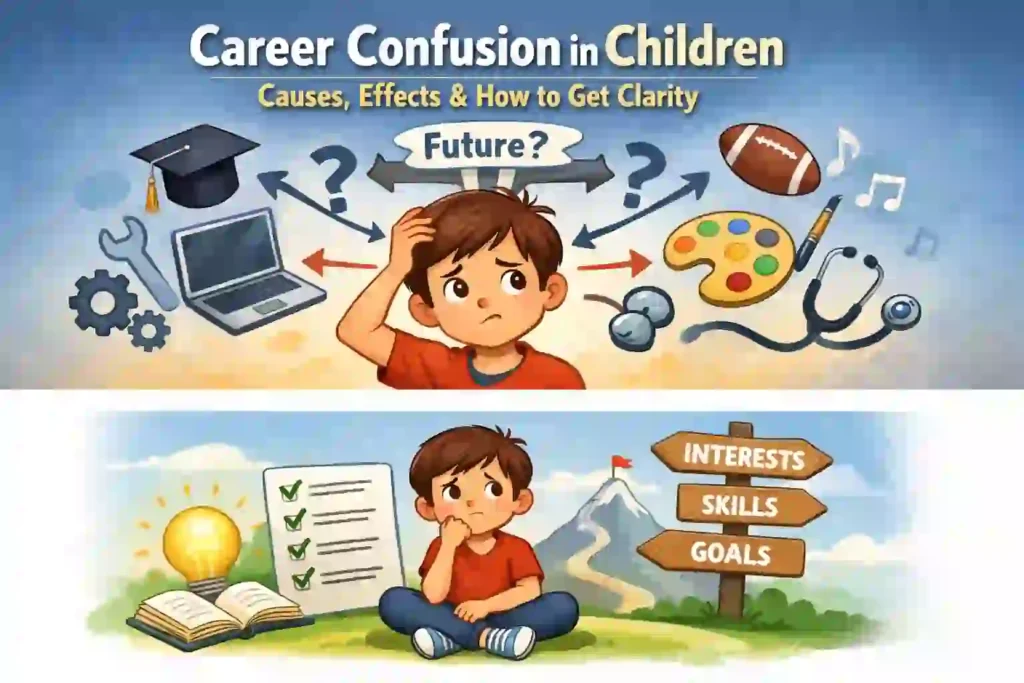
Career confusion in children is becoming one of the most common yet least understood challenges faced by parents today. Many children appear distracted, anxious, or unsure about their future—not because they lack ability, but because they are surrounded by expectations, comparisons, and conflicting messages.
From a very young age, children are repeatedly asked what they want to become, even while they are still discovering who they are. Academic pressure, social media influence, parental aspirations, and early exposure to competition often create confusion rather than clarity.
As parents, you may notice loss of interest in studies, frequent changes in ambition, fear of failure, or emotional withdrawal, yet struggle to understand the underlying cause. Career confusion in children is rarely about laziness or lack of intelligence; it is often a signal of misalignment between a child’s natural strengths, interests, and the path they are being told to follow by parents, guardians, teachers, or elders around them. Understanding this confusion is the first step toward supporting children with patience, clarity, and informed guidance instead of pressure.
Here is what nobody tells you openly about this crisis. Career confusion in children is not about being indecisive or careless about the future. Instead, it stems from overwhelming pressure, limited exposure to career options, and the absence of proper guidance at critical decision points. Your child is drowning in choices they do not understand, pressured by expectations they cannot meet, and scared of making mistakes that might “ruin their life” forever.
Stay with me through this entire article. By the end, you will have a complete action plan to help your child move from confusion to clarity, from anxiety to confidence. Plus you will understand exactly why this confusion happens, how it affects your child’s mental health, and what steps you must take starting today to turn things around.
Why Career Confusion in Children is Becoming an Epidemic in India
The scale of this problem is staggering beyond imagination. Over 1.5 crore students appeared for 10th board exams across India in 2025. Among them, 72% reported feeling confused about career choices according to data from the National Career Service. That means nearly 1.08 crore children are struggling with this issue every single year. And these numbers only account for students who admit to feeling confused. The actual figure could be much higher.
Here is what makes this crisis worse in India compared to other countries. Our education system forces children to make life-altering career decisions at age 15 after 10th grade. They must choose between Science, Commerce, or Arts streams without understanding what each path truly leads to. Beyond that, India has over 250 career options available today according to the All India Council for Technical Education.
However, most children only know about 10-15 traditional options like doctor, engineer, teacher, lawyer, or government officer. The remaining 235+ options remain invisible to them because nobody talks about them at home or school. Simply put, our children are making huge decisions with extremely limited information. And this information gap creates massive confusion.
5 Major Causes Behind Career Confusion in Children
Understanding the exact causes helps you solve the problem faster. Here are the five main reasons why career confusion in children has reached crisis levels in India today.
Parental Pressure and Limited Exposure
Parents unknowingly create confusion by pushing their unfulfilled dreams onto children. So a father who wanted to become an engineer pushes his artistic child toward IIT coaching. Meanwhile, successful doctor parents expect their children to continue the family legacy regardless of the child’s interests. Plus most children grow up knowing only about careers they see around them. Teachers, doctors, engineers are visible. However, careers like genetic counselor, ethical hacker, sports psychologist remain unknown. In fact, a study by the Indian Journal of Psychiatry found that 68% of confused students cited parental pressure as a major factor.
Social Media Comparisons and Information Overload
Today’s children constantly see peers posting achievements on Instagram and LinkedIn. One friend gets into IIT. Another cracks NEET on first attempt. These posts create intense pressure and self-doubt. Meanwhile, children search “best career options” on Google and get 10 crore results. Each website says something different. This combination of constant comparison and information tsunami paralyzes decision-making instead of enabling it. So children feel more confused after researching than before.
Outdated School Systems
Most Indian schools offer zero career counseling or have one counselor for 2000+ students. The counseling sessions focus on filling stream selection forms rather than understanding student interests, strengths, and personality types. Plus the education system demands career-defining choices at age 15 when adolescent brains are still developing decision-making abilities. Research shows the prefrontal cortex responsible for long-term planning matures only by mid-20s. Therefore, we ask children to make permanent decisions before they are developmentally ready.
Fear of Making Wrong Choices
Indian society treats career decisions as permanent and irreversible. Children hear stories of people whose lives got “ruined” because they picked the wrong stream or college. This fear of making mistakes becomes so intense that children freeze completely. They cannot move forward because every option seems risky. And this fear-based paralysis looks like confusion to outsiders.
Understanding Career Confusion in Children Through Self-Awareness
Most children have never taken proper career assessment tests that reveal their interests, aptitudes, personality types, and learning styles. They do not know if they are introverted or extroverted, analytical or creative, detail-oriented or big-picture thinkers. Without this self-knowledge, matching oneself to suitable careers becomes impossible. Therefore, confusion continues because the foundation of self-awareness is missing.
The Hidden Effects of Career Confusion in Children
Career confusion in children is not just an academic issue. Instead, it severely impacts mental health, family relationships, and overall wellbeing. Anxiety disorders are the most common effect of prolonged career confusion. Children develop sleep problems, appetite changes, and constant worry about the future. Many experience panic attacks before board exams or stream selection deadlines. Depression rates are also rising among confused students. Some develop low self-esteem thinking they are “not smart enough” to figure out their career path.
Academic Performance Decline
Confused children lose motivation to study because they see no clear purpose. So their grades start dropping even if they were good students before. Plus the mental energy spent worrying about career decisions leaves less capacity for learning. Therefore, confusion creates a downward spiral where poor grades further increase confusion and anxiety.
Strained Family Relationships
Career confusion often leads to daily conflicts at home. Parents get frustrated with the child’s inability to decide. Meanwhile, children feel misunderstood and unsupported. They stop sharing their fears with parents. And this communication breakdown damages the parent-child bond precisely when children need support most. Beyond that, confused children often withdraw from friends and social activities. They avoid gatherings where career topics come up because someone will inevitably ask “What are your plans?”
How Career Confusion in Children Affects Physical Health
The chronic stress from career confusion manifests as physical symptoms too. Headaches, stomach problems, fatigue, and frequent illnesses become common. Some children develop stress-related conditions like irritable bowel syndrome or chronic tension headaches. Their immune systems weaken due to constant anxiety. And these physical problems add another layer of difficulty to an already struggling child.
Warning Signs of Career Confusion in Children Parents Must Know
Your child constantly changes their mind about future plans. One week they want commerce, next week science seems better, then arts feels right. This flip-flopping shows deep uncertainty. Also your child avoids conversations about careers, streams, or college admissions. They change the topic, give vague answers, or get irritated when you bring it up. Plus they spend excessive time on social media comparing themselves to peers instead of focusing on their own path.
Another major sign is when your child cannot explain why they want a particular stream or career. They say “everyone takes science” or “my friend is doing commerce” without any personal reasoning. Watch for emotional signs too. Frequent mood swings, crying episodes, or angry outbursts about “not knowing what to do” are red flags. Some children become perfectionist and anxious, fearing they will make wrong choices. Others become apathetic and say “nothing matters” which masks deep confusion. Finally, physical symptoms like sleep problems, appetite changes, or stress-related illnesses without clear medical cause often stem from career confusion anxiety.
The Parent’s Role in Solving Career Confusion in Children
Parents are the most powerful factor in helping children overcome career confusion. Your child needs to feel safe expressing confusion without judgment or criticism. So when they say “I don’t know what I want,” respond with empathy instead of frustration. Tell them it is okay to be confused at this stage. Many successful people took years to find their path.
Stop Projecting Your Dreams onto Them
The hardest thing for parents is accepting that their children might choose different paths than what parents hoped for. However, forcing your unfulfilled dreams onto children never works. It only creates resentment and confusion. Instead, focus on understanding your child’s natural strengths, genuine interests, and personality type. Support their exploration even if it leads to careers you do not understand or value initially.
Expose Them to Diverse Career Options
Take active steps to expand your child’s career awareness. Arrange conversations with professionals in different fields. Take them to career fairs and college open houses. Show them documentaries and books about various professions. Plus encourage part-time internships or volunteer work during vacations. These real-world exposures often bring sudden clarity by showing children what they love or hate doing.
Focus on Strengths Instead of Only Marks
Help your child identify their core strengths beyond academic performance. Are they good with people? Do they solve problems creatively? Can they focus on details for hours? These strengths matter more than marks in finding suitable careers. So shift conversations from “what marks did you get” to “what did you enjoy learning most this month.”
5-Step Action Plan to Resolve Career Confusion in Children
Here is a detailed roadmap to move your child from confusion to clarity systematically. Follow these steps in sequence for best results.
Step 1 – Start with Comprehensive Career Assessment
Get your child professionally assessed using scientifically validated tools. Good career assessment tests examine interests, aptitudes, personality types, values, and learning styles. Tests like Strong Interest Inventory, Myers-Briggs Type Indicator, and Holland Code assessment provide valuable insights. These tests cost ₹1,500 to ₹5,000 but give your child language to understand themselves beyond just saying “I’m confused.” The assessment report becomes the foundation for all future career exploration.
Step 2 – Create a Career Exploration Plan for 3 Months
Based on assessment results, identify 5-7 career options that match your child’s profile. Then spend 3 months exploring these options deeply. For each career, your child should research daily tasks, required education, salary ranges, and growth prospects. They should read interviews with professionals and watch day-in-life videos. This intensive exploration brings clarity by converting abstract career names into concrete understanding of what that life would actually look like.
Step 3 – Try Before You Commit Through Micro-Experiences
Arrange short-term experiences in shortlisted career fields through weekend workshops, online courses, part-time internships, or shadowing professionals. For example, if considering architecture, take a 2-day AutoCAD workshop. Interested in psychology? Volunteer at a mental health helpline. These micro-experiences help children test career options before long-term commitments. Often, what seemed interesting in theory becomes clearly unsuitable after practical exposure. And that saves years of going down wrong paths.
Step 4 – Match Careers to Stream Choices Logically
After identifying suitable careers, work backwards to determine which stream supports those careers. This reverses the typical approach where stream choice comes first. Instead, career choice comes first, then stream follows logically. Plus this gives your child clear reasons for stream selection. Now they can say “I’m taking science with biology because I want to be a genetic counselor” instead of generic statements.
Step 5 – Create a 3-Year Roadmap with Milestones
Once stream and career direction are clear, create a detailed 3-year plan for Classes 11-12 and college preparation. Break this into semester-wise goals and monthly milestones. Include academic targets, skill development activities, and entrance exam preparation timelines. This roadmap transforms abstract future into concrete near-term actions. And when children see clear next steps, anxiety reduces significantly.
Why Professional Career Guidance Matters
Professional career counselors play crucial roles that parents cannot fulfill despite best intentions. Career counselors offer objective, unbiased guidance based purely on child’s best fit without emotional baggage. They stay updated on emerging career fields like behavioral economics, computational biology, or blockchain consulting that most parents have never heard of. Plus they use scientifically validated assessment tools and know how to interpret results correctly.
Established career counselors have networks across industries. They can arrange conversations between students and professionals. They share insider knowledge about what it really takes to succeed in different fields. Beyond that, career clarity requires sustained effort over months. Professional counselors provide accountability through regular check-ins, follow up on exploration activities, and keep students motivated during the clarity-building journey.
The Indian government’s National Career Service portal (https://www.ncs.gov.in/) offers free career counseling resources. However, for personalized guidance, invest in reputed career counseling firms. Organizations like Mindler, CareerGuide, and iDreamCareer operate across India with fees ranging from ₹5,000 to ₹25,000. Consider this an investment in your child’s future rather than an expense. The cost is minimal compared to costs of wrong career decisions where lakhs get spent on courses leading nowhere.
5 Mistakes Parents Make That Worsen Career Confusion in Children
Avoiding these common mistakes saves children from prolonged confusion and anxiety.
Dismissing Their Feelings and Rushing Decisions
When children express confusion, many parents respond impatiently saying “just pick something.” This pressures them into hasty decisions that lead to wrong choices requiring painful course corrections later. Instead, acknowledge confusion as normal and give children time to work through it systematically.
Comparing with Others’ Children
Statements like “Sharma ji’s son already got into engineering” create damaging comparisons. Every child develops at their own pace. Comparing only increases anxiety and makes children choose careers to match others rather than their own fit.
Limiting Options to Only Traditional Careers
Many parents discourage unconventional careers due to fear of instability. So when children show interest in design or psychology, parents push them toward engineering or medicine. This limiting of options prolongs confusion because true interests remain unexplored. Many unconventional careers offer excellent income when pursued seriously.
Ignoring Mental Health Impact
Parents focus on academics while missing anxiety or depression signs. They think “once career is decided, mental health will improve automatically.” However, untreated mental health issues make career clarity harder. Therefore, address mental health alongside career counseling.
Not Investing in Professional Guidance
Some parents try handling career confusion entirely by themselves. While involvement is good, it is insufficient for seriously confused children. Professional counselors have training and tools parents lack. So invest in expert guidance when confusion persists.
Common FAQs About Career Confusion in Children
Q: At what age should children start career exploration?
Career exploration should ideally begin by Class 8 or age 13 years through informal exposure. This gives 2 years before stream selection. However, formal career assessment and counseling work best in Class 9 or early Class 10. Starting too early may not yield meaningful results as interests are still developing. But starting too late means making decisions in panic mode.
Q: How long does it take to resolve career confusion in children?
The timeline varies based on confusion severity. Mild confusion with proper guidance resolves in 2-3 months. Moderate confusion needing extensive exploration takes 4-6 months. Severe confusion complicated by anxiety may need 8-12 months of consistent counseling. Rushing this process backfires. So give your child sufficient time with proper guidance.
Q: Can career confusion happen even after choosing a stream?
Yes, absolutely. Many children pick streams under pressure or limited information, then realize after joining Class 11 that they made wrong choices. Post-stream confusion is common and stressful because switching becomes difficult. If this happens, evaluate seriously whether switching streams is better than spending 2 years in unsuitable subjects. Remember that stream choice is not forever through courses and experience later.
Q: What if my child wants a career with low salary potential?
Salary concerns are valid but should not be the only factor. Many careers start with modest salaries but offer good growth. Help your child understand financial realities including earnings and lifestyle possible at those income levels. Then let them make informed choices. Some people accept lower salaries for work they love. The key is making informed choices.
Q: How do I know if counseling is working?
Signs of progress include your child researching careers independently, expressing preferences even if tentative, showing reduced anxiety, and engaging in exploration activities willingly. The process is working when children move from “I have no idea” to “I’m considering 3 options and actively exploring them.” Complete clarity may not come immediately, but you should see movement from paralysis to exploration within 4-6 weeks.
Take Action Today to End Career Confusion in Children
We covered extensive ground in this guide. From understanding why career confusion in children has reached crisis levels to detailed action plans for resolution. From identifying warning signs to learning from success stories. Simply put, you now have complete knowledge to help your child move from confusion to clarity systematically.
But here is the critical point. Just reading changes nothing at all. Your child is still confused right now as you finish reading this. However, taking even small action today can start the transformation. So here is what I want you to do immediately before closing this page.
First, have an honest conversation with your child tonight about their confusion. Tell them confusion is normal and you are committed to supporting them through it. Second, book a career assessment test this week through National Career Service portal or a reputed counseling firm. Third, identify one professional in a field your child might be interested in and arrange a 30-minute conversation within next 10 days. Finally, commit to spending 2 hours every weekend for next 3 months on career exploration activities together.
Small consistent steps taken today prevent years of regret and struggle later. Your child’s future depends not on reading guides but on implementing insights from them. So act now, not next month or when exams finish or when you feel ready. The right time is always today. Start helping your child find career clarity today, and watch anxiety transform into confidence over coming months.
External Resources for Career Guidance
– National Career Service Portal: https://www.ncs.gov.in/ – Government platform offering free career counseling resources and job listings.
– All India Council for Technical Education: https://www.aicte-india.org/ – Official information about technical education programs and career options.
– Indian Council of Medical Research: https://www.icmr.gov.in/ – Resources about medical education and healthcare professions.
– National Skill Development Corporation: https://www.nsdcindia.org/ – Information about vocational training and skill certifications.
– Ministry of Education: https://www.education.gov.in/ – Government initiatives and resources for student career guidance.
Your future begins with making the right choice today. Start Now!
GlobalCareerLabs.com
Your Partner in Career Success
Related Resources for Career counsellor certification:
– What to Do After 12th: Your Ultimate Guide to Successful Careers
– Courses After 12th: 100+ Best Options for Bright Future
– NEET Preparation 2026: Your Complete Strategy & Planning For Success
– JEE Main Preparation 2026: Proven Strategy for Sure Success
– Career Counselling in India: Complete Guide for Students
– Career Options After 10th: Successful Career Paths for Students
– Courses After 12th: 100+ Best Options for Bright Future
– What to Do After 12th: Your Ultimate Guide to Successful Careers
– Best Colleges in India: Your Complete Guide
– Sarkari Naukri: Complete Guide to Govt Jobs in India
– Best Career Options After 12th: Successful Careers for You
– Best Fashion Design Careers in India: Your Ultimate Guide
– Fashion Designing Course After 12th: Eligibility, Fees & Best Options
– How to Choose the Right Career After 12th: 5-Step Framework for Students
– Digital Marketing Career After 12th: Complete Guide for Students in 2026
– BBA vs BCom After 12th: Which is Better?
– Top Careers in Animation After 12th: Best Courses in India in 2026
– BSc Nursing vs B Pharma vs BPT: Best Career in 2026
– Aviation Career After 12th: Career Options in 2026
– Engineering vs Medical After 12th: Which is Better?
– Hotel Management Career After 12th: Complete Career Guide
– Top 10 Diploma Courses After 12th
– Career Options After 12th Arts: Complete Guide for 2026
– Commerce Without Maths Career – Best Career Options 2026: Complete Guide
– Confused After 12th? 7-Step Career Decision Framework
– 6 Month Courses After 12th: Smart Career Launch Guide for Indian Students
– Career Options After 12th in India: Complete Guide to Making the Right Choice in 2025
– Commerce Career Options After 12th for Girls in India 2025 – Complete Guide
– Creative Careers After 12th (Non-Engineering) in India: Your Complete Guide 2025
– Career Options for Girls After 12th India: Complete Guide
– Arts vs Commerce After 12th: Which to Choose in 2025?
External Resources for Career counsellor certification:
– National Skill Development Corporation
– National Skill Development Corporation
Disclaimer:
Salary figures, course fees and other course details & career information provided in this article are for general reference only and may vary based on location, company, experience & market conditions. So, readers are advised to independently verify all information from official and authentic sources before making any career or educational decisions. GlobalCareerLabs.com does not guarantee the accuracy or authenticity of this data. And so, Global Career Labs shall not be held responsible for any decisions made based on this information.
Related posts:
 Career Counsellor: Your Complete Guide to Finding the Right Counsellor
 Best Career for Me: Complete Self-Discovery -Aptitude & Personality Tests
 Career Aptitude Test: Choose Your Right Career Path Now in 2026
 ITI Courses After 10th: Complete Guide to Best Trades & High Salary Jobs in 2026
 Central Government Jobs: Your Ultimate Career Guide for 2026
 Best Skills to Learn in 2026: Guaranteed Career Success
 Best Stream After 10th: Plan your next move now
 Career Counselling After 12th: Ultimate Guide for Career Planning
 Psychometric Test for Career: Unlock Your Right Career Path
 Personality Development: Your Key To Ultimate Career Success
 Best Private Colleges: Your Complete Guide to Top Education
 Which Career Is Best for Me: Ultimate Guide to “Best Careers”
 State Government Jobs: Stress Free, Stable & Secure careers
 How to Become A Data Scientist in 2026 Without Coding Knowledge: Earn More than ₹10 LPA Salary
 Data Science Career 2026: Complete guide to high paying jobs in AI Era
 Career Counselling Near Me: Find The Best Career Counsellor
 Cyber Security Jobs: Best Career Options for 2026
 Cybersecurity Jobs for Freshers: How to Get Hired 2026
 Professional Courses After 12th: Best Courses for High Salary Careers
 Career Counsellor Certification: Ultimate Guide to becoming a successful Counsellor
Powered by YARPP.