
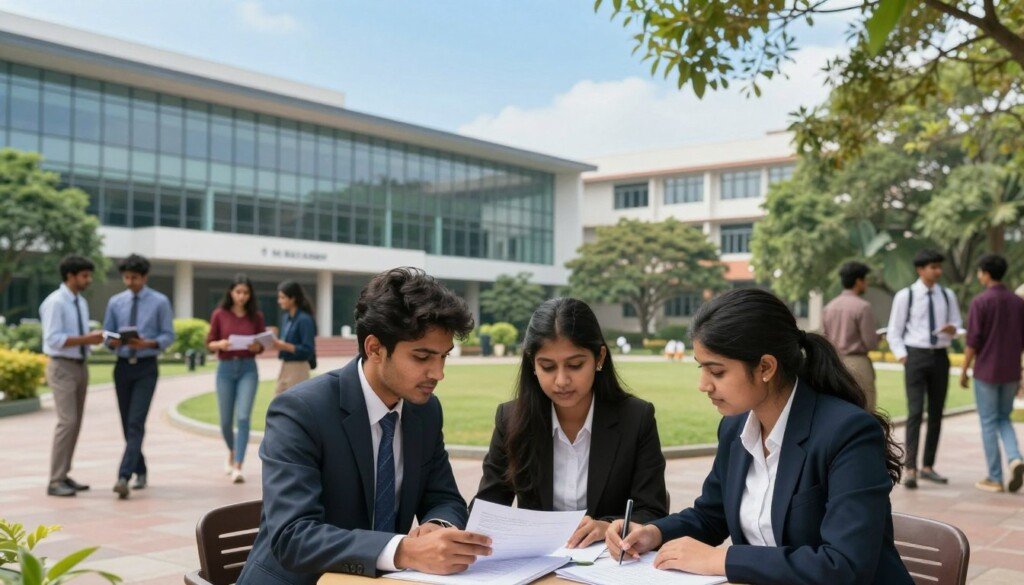
Deciding to pursue an MBA is one thing — deciding where & which college, is an entirely different and far more consequential conversation. The institution you choose shapes not just your two years of study but your professional network, your salary trajectory, and your credibility in the job market for decades ahead. That’s exactly why serious aspirants spend considerable time researching top MBA colleges in India before submitting a single application. The difference between a well-chosen college and a hastily picked one can be measured in lakhs of rupees of salary — every single year.
IIM Ahmedabad, IIM Bangalore, and IIM Calcutta consistently anchor the top of every credible ranking — and for good reason. Their placement records, alumni networks, faculty depth, and global recognition are genuinely in a different league. But the story doesn’t end at the older IIMs. Newer IIMs at Kozhikode, Indore, and Lucknow have built formidable reputations of their own. Add to that the management programmes at IITs, XLRI Jamshedpur, MDI Gurgaon, SP Jain Mumbai, and FMS Delhi — and the landscape of quality MBA education in India is richer and more competitive than it has ever been.
Fees, specialisations, entrance exam requirements, and average placement packages vary significantly across these institutions — and understanding those differences is what separates a smart application strategy from a scattergun one. Some colleges offer exceptional value at moderate fees; others charge a premium that their placement outcomes genuinely justify. The 2026 rankings also reflect newer evaluation parameters — research output, diversity, international collaborations, and entrepreneurship outcomes are all now part of the picture. This guide cuts through the noise so you can identify the colleges that genuinely match your profile, your budget, and your career ambitions.
Key Points for You
- Top MBA colleges in India in 2026 span IIMs, IITs, and elite private institutions — each with distinct strengths and placement profiles.
- IIM Ahmedabad, Bangalore, and Calcutta remain the gold standard, with average placements consistently among the highest in Asia.
- Newer IIMs and strong private schools like XLRI, MDI, and FMS offer excellent outcomes at comparatively more accessible fee structures.
- MBA college rankings in 2026 now factor in research, diversity, global tie-ups, and entrepreneurship outcomes alongside placement data.
- Fee structures vary enormously — from ₹2–3 lakhs at FMS Delhi to ₹25+ lakhs at top private and older IIM campuses.
- Matching your CAT or GMAT score, work experience, and career goals to the right college is more important than chasing rankings alone.
Understanding the MBA Landscape in India for 2026
India has over 5,500 MBA colleges, making it hard to choose. But, knowing the MBA scene can guide you. The sector includes public, private, and government schools. This variety means lots of chances for MBA students.
Why Pursuing an MBA Remains a Strategic Career Move
Getting an MBA can change your career path. It boosts your knowledge, skills, and networking. An MBA prepares you for the business world, making you stand out.
In India, an MBA is very valuable. It teaches you about business, leadership, and strategy. Employers love these skills.
Types of MBA Programmes Available in India
India has many MBA programmes for different needs. You can choose from full-time, part-time, executive, and online MBAs. Each is made for different professionals.
Full-time MBAs are great for learning a lot. Part-time and executive MBAs are for those working, wanting to improve without quitting their jobs.
Recognising Accreditation Bodies and Their Importance
Choosing an MBA means looking at accreditation. In India, AICTE and ACBSP are key. They check if schools meet quality standards.
Accreditation means the school is up to par. It checks on faculty, facilities, and courses. Make sure your MBA is accredited to be valued by employers.
| Accreditation Body | Role | Relevance to MBA Programmes |
|---|---|---|
| AICTE | Regulates technical education | Ensures quality and standards in MBA education |
| ACBSP | Accredits business schools | Validates the quality of MBA programmes |
| AMBA | Accredits MBA programmes globally | Enhances international recognition of MBA degrees |
How to Choose the Right MBA College for Your Career Goals
Choosing the right MBA college is a big decision that can shape your future. It’s important to take a step-by-step approach to make the right choice.
Step 1: Assess Your Career Objectives and Preferred Specialisations
First, define your career goals and specialisations you’re interested in. Are you looking to switch industries or move up in your current field? Knowing your goals helps narrow down your options.
If finance is your interest, look at colleges with strong finance programs. For example, the Indian School of Business (ISB) or the Indian Institute of Management (IIM) Ahmedabad are good choices.
Step 2: Evaluate College Reputation and Alumni Network Strength
The reputation of the MBA college and its alumni network are key. A good reputation can lead to better job opportunities. A strong alumni network offers valuable connections and mentorship.
Colleges like IIM Bangalore and XLRI Jamshedpur have strong reputations and networks. These can be great for your career.
Step 3: Consider Location and Industry Connections
The location of the MBA college and its industry connections matter too. A college in a major city or industrial hub can offer more internship and job opportunities.
For example, MBA colleges in Mumbai, Delhi, or Bangalore are close to big industries. This can increase your chances of getting a job in top companies.
Step 4: Understand NIRF Rankings and Other Assessment Parameters
NIRF rankings and other assessment parameters give insights into MBA college quality. Knowing these rankings helps you make a better choice.
The table below compares some top MBA colleges in India. It looks at NIRF rankings and other important factors:
| College Name | NIRF Ranking | Average Package (₹ Lakhs) | Specialisations Offered |
|---|---|---|---|
| IIM Ahmedabad | 1 | 25 | Finance, Marketing, HR |
| IIM Bangalore | 2 | 22 | Finance, Marketing, Operations |
| XLRI Jamshedpur | 3 | 20 | HR, Finance, Marketing |
Top 50 MBA Colleges in India: Complete Rankings for 2026
Exploring MBA education in India reveals the best B-schools for a career boost in 2026. The Indian MBA scene is competitive, with many schools offering programmes that meet industry needs.
Top MBA colleges in India stand out for their academic excellence and strong connections. They provide a solid academic base and chances for personal and professional growth.
Top 10 IIMs and Premier B-Schools
The Indian Institutes of Management (IIMs) are India’s most prestigious business schools. They are known for their rigorous programmes and successful alumni. Here are the top IIMs and premier B-schools for 2026.
IIM Ahmedabad
IIM Ahmedabad is a top B-school in India, known for its academic rigour and industry ties. The MBA programme fees range from ₹2.32 lakhs to ₹23.50 lakhs. Average placement salaries can reach up to ₹45 lakhs per year.
IIM Bangalore
IIM Bangalore offers a world-class MBA programme. Programme fees range from ₹3.50 lakhs to ₹25 lakhs. Top recruiters offer salaries up to ₹40 lakhs per year.
IIM Calcutta
IIM Calcutta is one of the oldest and most respected IIMs. It offers a comprehensive MBA programme with various specialisations. Fees range from ₹2.50 lakhs to ₹22 lakhs. Average placement salary is around ₹35 lakhs per year.
IIM Lucknow and IIM Kozhikode
IIM Lucknow and IIM Kozhikode are top IIMs known for their academic programmes and industry ties. Fees range from ₹2.20 lakhs to ₹20 lakhs. Average placement salaries are up to ₹30 lakhs per year.
Other Leading IIMs
Other leading IIMs, like IIM Indore and IIM Shillong, are also worth considering. They offer various specialisations and have a strong track record of placements.
Leading Private MBA Institutions (Ranks 11-25)
There are several private MBA institutions that have made a mark in the rankings. These institutions offer a range of programmes and have strong industry connections.
XLRI Jamshedpur, FMS Delhi, and SP Jain Mumbai
XLRI Jamshedpur, FMS Delhi, and SP Jain Mumbai are leading private MBA institutions. They offer various specialisations and have a strong reputation for placements. Average salaries range from ₹20 lakhs to ₹30 lakhs per year.
ISB Hyderabad and MDI Gurgaon
ISB Hyderabad and MDI Gurgaon are prominent institutions offering high-quality MBA programmes. Fees range from ₹20 lakhs to ₹34.50 lakhs. Top recruiters offer salaries up to ₹40 lakhs per year.
Emerging and Established MBA Colleges (Ranks 26-50)
The lower rungs of the top 50 list feature emerging and established MBA colleges. These institutions offer a range of programmes and are worth considering for an MBA.
When choosing an MBA college, consider fees, placement records, and specialisations. This helps make an informed decision that aligns with your career goals.
Step-by-Step MBA Admission Process in India
Starting your MBA journey in India means knowing the admission process well. It involves entrance exams, application prep, and a detailed selection process.
Step 1: Register and Prepare for Entrance Examinations
To get into a top MBA college in India, first, register for entrance exams. You can apply to the best MBA colleges through exams like CAT, XAT, MAT, CMAT, ATMA, etc.
Common Admission Test (CAT)
The Common Admission Test (CAT) is a key MBA entrance exam in India. It’s run by the Indian Institutes of Management (IIMs). It tests your quantitative, data interpretation, and verbal skills.
XAT, GMAT, MAT, and CMAT
Other major exams include XAT, GMAT, MAT, and CMAT. Each has its own pattern and is accepted by many B-schools across India.
“The key to cracking MBA entrance exams lies in understanding the exam pattern, consistent practice, and strategic preparation.”
Step 2: Prepare Your Application Documents and Academic Records
After passing the entrance exam, prepare your application documents. This includes your academic transcripts, work experience certificates, and letters of recommendation.
| Document | Description |
|---|---|
| Academic Transcripts | Mark sheets and degree certificates from previous academic institutions. |
| Work Experience Certificates | Certificates from previous employers, highlighting your work experience and achievements. |
| Letters of Recommendation | Letters from academic or professional referees, recommending you for the MBA programme. |
Step 3: Excel in Written Ability Tests and Group Discussions
Many B-schools in India use Written Ability Tests (WAT) and Group Discussions (GD). WAT tests your writing skills, while GD checks your communication and teamwork.

Step 4: Master the Personal Interview Round
The Personal Interview (PI) round is key. It lets the admissions committee see your personality, goals, and fit for the programme.
- Prepare to discuss your academic background and work experience.
- Be ready to articulate your career goals and reasons for pursuing an MBA.
- Showcase your knowledge of current affairs and business trends.
Step 5: Navigate Final Selection and Secure Admission
The last step is to navigate the selection process and secure admission. This means getting an offer from your preferred B-school and completing the formalities.
Key Takeaways:
- Understand the MBA admission process in India.
- Prepare for entrance examinations like CAT, XAT, MAT, CMAT, and ATMA.
- Excel in WAT, GD, and PI rounds.
MBA Fees Structure Across Top 50 Colleges
When looking at the top 50 MBA colleges in India for 2026, knowing the fees is key. The cost of an MBA varies a lot. This depends on the school, its fame, location, and the MBA program.
Fee Range at IIMs and Premier Institutions
The Indian Institutes of Management (IIMs) are top business schools in India. Their fees show their high standing. Fees at IIMs range from ₹20 lakhs to ₹25 lakhs for the whole program. For example, IIM Ahmedabad’s MBA program costs about ₹22 lakhs.
Other top schools like XLRI Jamshedpur and Faculty of Management Studies (FMS), Delhi also have high fees. XLRI Jamshedpur, for instance, charges around ₹23 lakhs for its MBA program.
| Institution | Fee Range (₹ Lakhs) | Average Placement Package (₹ LPA) |
|---|---|---|
| IIM Ahmedabad | 22 | 25-35 |
| IIM Bangalore | 23 | 25-35 |
| XLRI Jamshedpur | 23 | 20-30 |
Private B-School Fee Structures and What They Include
Private B-schools in India offer various MBA programs with different fees. Fees can be from ₹8 lakhs to ₹20 lakhs. For example, Xavier School of Management (XLRI) and SP Jain Institute of Management and Research (SPJIMR) charge around ₹20 lakhs and ₹18 lakhs, respectively.
It’s important to know what the fees cover. Usually, they include tuition, accommodation, and other facilities. Some schools also offer career advice, placement help, and access to alumni networks.
“The fee structure is not just about the cost; it’s about the value you receive from the institution.”
Government and State University MBA Programmes
Government and state university MBA programs are more affordable. Fees range from ₹2 lakhs to ₹5 lakhs. For example, Faculty of Management Studies (FMS), Delhi charges less than private schools.
These programs are not only cheaper but also provide quality education. They are often linked to well-known government universities.
How to Secure Financial Aid, Scholarships, and Education Loans
Many students use financial aid, scholarships, and loans to fund their MBA. Scholarships are based on merit or need and can help a lot. For example, some IIMs offer scholarships based on academic performance and entrance exam scores.
Education loans are another good option. Banks and financial institutions offer loans with different interest rates and repayment plans. It’s important to compare and choose the best loan for you.
To get financial aid, start researching and applying for scholarships and loans early. Also, don’t hesitate to ask the financial aid office of your chosen school for advice.
Placement Statistics and Salary Packages in Top MBA Colleges
Top MBA colleges in India boast impressive placement records and high salary packages. When thinking about an MBA, it’s key to look at these stats. They can help you decide if an MBA is right for you.
Average and Highest Salary Packages in Lakhs (₹)
Salaries at top MBA colleges in India are very attractive. At places like the Indian Institutes of Management (IIMs), students can earn around ₹25–35 lakhs a year. The highest salaries can go up to ₹50 LPA or more, based on the job and company.
IIM Ahmedabad, for example, sees average salaries of about ₹30 LPA. The highest can reach ₹60 LPA. IIM Bangalore and IIM Calcutta also offer salaries between ₹25–30 LPA on average.
Top Recruiting Companies: TCS, Infosys, Deloitte, ICICI Bank, and More
Top MBA colleges in India draw big names for campus placements. Companies like TCS, Infosys, and Wipro, along with banks like ICICI and HDFC, are regulars. Consulting firms like Deloitte and KPMG also join in.
These companies offer jobs in finance, marketing, HR, and operations. This variety means students have many career paths to explore.
Sector-Wise Placement Trends for 2026
Placement trends show a big demand for MBA graduates in finance, consulting, and IT. Finance is a big player, with jobs in investment banking, asset management, and financial analysis in high demand.
- Finance: Investment banking, asset management, and financial analysis
- Consulting: Strategy consulting, operational improvement, and IT consulting
- IT: Product management, business analysis, and IT consulting
Calculating Your Return on Investment
When thinking about an MBA, it’s important to look at the return on investment (ROI). You need to compare the programme’s cost to the potential salary and career growth.
To figure out ROI, use this formula: ROI = (Gain from Investment – Cost of Investment) / Cost of Investment. For MBA programmes, the gain includes salary and benefits, while the cost is tuition and living expenses.
By looking at the placement stats and salaries of top MBA colleges, you can make a smart choice about your MBA. This will help you understand the potential ROI.
MBA Career Options and Specialisations to Consider
The MBA world in India is full of career paths and specialisations. These can boost your career and personal growth. An MBA degree can be a key to unlocking new opportunities.
There are many specialisations to choose from. You can pick one that matches your interests and career goals. Popular choices include finance, marketing, human resources, operations, and consulting.
Finance and Investment Banking Opportunities
Finance and investment banking offer both challenges and rewards. With a finance MBA, you can become an investment analyst, portfolio manager, or financial consultant. Big names like ICICI Bank, HDFC Bank, and Goldman Sachs look for MBA talent in these fields.
Experts say the finance sector is a big employer of MBA graduates. Investment banking is a favourite for those who love deal-making and financial analysis.
“The finance sector is a major driver of the Indian economy, and MBA graduates with a finance specialisation are in high demand.”
| Finance Specialisation | Average Salary (₹ Lakhs) | Top Recruiters |
|---|---|---|
| Investment Banking | 12-20 | Goldman Sachs, Morgan Stanley |
| Financial Management | 8-15 | ICICI Bank, HDFC Bank |
| Portfolio Management | 10-18 | Franklin Templeton, DSP Investment Managers |
Marketing and Brand Management Roles
Marketing and brand management are great for those who love creativity and understanding people. With a marketing MBA, you can become a brand manager, marketing manager, or product manager. Companies like Procter & Gamble, Hindustan Unilever, and Coca-Cola often hire MBA graduates for marketing roles.
Human Resources and Organisational Development
Human resources and organisational development shape the culture and talent of companies. With an HR MBA, you can become an HR manager, talent acquisition manager, or organisational development manager. Tata Consultancy Services, Infosys, and Wipro often look for MBA talent in HR.
Operations and Supply Chain Management
Operations and supply chain management focus on the day-to-day of businesses. With an operations MBA, you can become an operations manager, supply chain manager, or logistics manager. Amazon, Flipkart, and Reliance Industries often hire MBA graduates for these roles.
Consulting and Strategy Positions
Consulting and strategy help businesses solve problems and improve. With a consulting MBA, you can become a management consultant, strategy consultant, or business analyst. Top firms like McKinsey, Boston Consulting Group, and Deloitte often seek MBA talent for their consulting teams.
How to Prepare for MBA Entrance Exams Whilst Managing Other Commitments
Preparing for MBA entrance exams while keeping up with other studies is a big challenge. Students in India face this when studying for exams like CAT, XAT, or MAT. They also have to manage JEE, NEET, or UPSC studies.
Creating a Realistic Study Schedule That Fits Your Life
Creating a study schedule that suits your life is key. First, look at your daily routine and find time for studying. Set aside specific times each day for studying, making sure you cover all needed topics.
For example, for CAT prep, use mornings for Quant, afternoons for Logical Reasoning, and evenings for Verbal. Being consistent is important; try to stick to your plan as much as you can.
Selecting the Best Resources and Coaching Institutes
Choosing the right resources and coaching is crucial. Look for coaching institutes with good study materials and mock tests. Top institutes in India include Career Launcher, TIME, and IMS.
Also, use online tools like mock test series and study forums to help your prep. Make sure these resources match the exam’s pattern and syllabus.
Balancing MBA Preparation with JEE, NEET, or UPSC Studies
Managing MBA prep with JEE, NEET, or UPSC exams needs careful planning. Look for topics or skills that overlap, like Logical Reasoning or Quantitative Ability.
| Exam | Common Topics with MBA Entrance Exams | Preparation Tips |
|---|---|---|
| JEE | Quantitative Ability, Logical Reasoning | Focus on strengthening your Quantitative Ability as it overlaps with JEE syllabus. |
| NEET | Time Management, Stress Handling | Practice time management techniques that can benefit both NEET and MBA preparations. |
| UPSC | General Awareness, Logical Reasoning | Enhance your General Awareness by staying updated with current affairs. |
Utilising Mock Tests and Developing Time Management Strategies
Mock tests are vital for MBA prep. They help you assess your strengths and weaknesses and improve your time management. Regular mock tests get you used to the exam format and syllabus.

Work on a time management strategy by doing sectional and full-length mock tests. After each test, review your performance to see where you need to improve.
Conclusion
Choosing the best MBA college in India is a big decision. It depends on your budget, career dreams, and where you want to study. There are many schools with different specialisations, offering lots of chances.
You now know about the various MBA courses and their costs. You also understand the job placement rates. This knowledge helps you pick the right college for your career goals.
When thinking about your mba career options, find a program that fits your goals. The right MBA college can set you up for success. For help choosing the best college and planning your career, visit GlobalCareerLabs.com.
Start working towards your career goals by using the resources and advice available. This will help you achieve your dreams in the MBA world.
Frequently Asked Questions
How can I identify the most reliable MBA colleges ranking for the 2026 academic year?
What are the primary steps involved in the mba admission process in India?
Are the mba fees in india manageable for students requiring financial assistance?
What kind of mba salary package can I expect after graduating from a top-50 B-school?
What are the most popular mba career options available to graduates today?
Can I apply for an MBA programme at an IIT if I am not an engineering graduate?
Ready to move forward in your studies and career?
Check out GlobalCareerLabs.com for tailored career advice. Their experts can guide you through the BBA course. They help you reach your highest potential.
Your future begins with making the right choice today. Start Now!
GlobalCareerLabs.com
Your Partner in Career Success
Related Resources:
– MBA Course Duration: Full-Time, Part-Time & Executive MBA 2026
– Best MBA Colleges in India 2026: Top 25 with Fees & ROI
– MBA Subjects List: Specialization-wise Syllabus Guide 2026
– MBA Courses List: All Specializations with Career Scope 2026
– Course Fees For MBA in India 2026: IIMs, Private & Government Colleges
– MBA Fees in India 2026: Complete Fee Structure Guide
– MBA Specialisations List: Which One is Best for You? 2026
– Data Science Jobs for Freshers: How to Get Your First Job 2026
– Data Science vs Data Analytics: Which is Better for Career?
– Comparison of Data Science and AI: Complete Career Guide for Indian Students 2026
– Data Science Internship: How to Get One as a Fresher in India 2026
– Data Science Course: Best Options & Career Path
External Resources for You
Explore these trusted authority sources to research MBA college rankings, fees, and placement outcomes across India:
- Indian Institutes of Management — CAT Portal — The official gateway to all IIM programmes across India, with updated admission criteria, fee structures, selection processes, and programme details for 2026 applicants.
- National Institutional Ranking Framework — NIRF — The Government of India’s official college ranking system, publishing annual management school rankings based on research, placements, outreach, and graduation outcomes.
- All India Council for Technical Education (AICTE) — The national regulatory body approving MBA programmes, with a searchable directory of recognised institutions, their accreditation status, and programme approval details.
- Graduate Management Admission Council (GMAC) — Publishers of the GMAT and leading global research on MBA programme quality, placement benchmarks, and business school rankings relevant to Indian aspirants targeting top colleges.
Disclaimer:
Salary figures, course fees and other course details & career information provided in this article are for general reference only and may vary based on location, company, experience & market conditions. So, readers are advised to independently verify all information from official and authentic sources before making any career or educational decisions. GlobalCareerLabs.com does not guarantee the accuracy or authenticity of this data. And so, Global Career Labs shall not be held responsible for any decisions made based on this information.
Related posts:
 Top MBA Colleges in India: Secrets to Getting Admitted 2026
 MBA Specialisations List: Which One is Best for You? 2026
 MBA Courses List: All Specializations with Career Scope 2026
 Cyber Security Jobs: Best Career Options for 2026
 Cybersecurity Jobs for Freshers: How to Get Hired 2026
 Digital Marketing Course 2026: How to Start a High-Paying Career
 Career Aptitude Test: Choose Your Right Career Path Now in 2026
 Central Government Jobs: Your Ultimate Career Guide for 2026
 Career Counsellor: Your Complete Guide to Finding the Right Counsellor
 Courses After 12th Commerce with Maths: Ultimate Career Guide
 B.Tech Colleges in India: Guaranteed Roadmap for Successful Tech Careers
 Career Counselling After 12th: Ultimate Guide for Career Planning
 Psychometric Test for Career: Unlock Your Right Career Path
 Personality Development: Your Key To Ultimate Career Success
 Best Private Colleges: Your Complete Guide to Top Education
 GATE Preparation for 800+ Score: This is Proven Strategy 2026
 How to Become A Data Scientist in 2026 Without Coding Knowledge: Earn More than ₹10 LPA Salary
 Data Science Career 2026: Complete guide to high paying jobs in AI Era
 Career Counselling Near Me: Find The Best Career Counsellor
 Career Counsellors in Kolkata: Know The Best Experts 2006
Powered by YARPP.