

There’s a moment most MBA aspirants go through — somewhere between shortlisting colleges and preparing for CAT — when the question shifts from “should I do an MBA?” to “what exactly will I be studying for two years?” It’s a fair question, and not enough people ask it early enough. The truth is, understanding MBA subjects before you choose a programme can make a significant difference in how well you perform, which specialisation you pick, and ultimately which companies recruit you. A Finance MBA and a Marketing MBA might share the same first semester — but they lead to very different careers.
What makes this worth thinking through carefully in 2026 is that the MBA curriculum has been evolving. Top institutions — IIMs, XLRI, SPJIMR — have integrated data analytics, business technology, and ESG (Environmental, Social & Governance) thinking into their syllabi alongside the traditional core subjects. So whether you’re targeting IIM Ahmedabad via CAT 2025 or a strong state-level B-school, knowing the full subject landscape puts you in a better position to prepare, choose, and succeed.
This guide covers the complete MBA subjects list — semester by semester, specialisation by specialisation — for Indian students planning their 2026 admissions.
Key Highlights Of This Article
- Semester-wise breakdown of core MBA subjects across all four semesters
- Specialisation-wise subject lists — Finance, Marketing, HR, Operations, IT, and more
- How AICTE’s model curriculum shapes what Indian MBA programmes actually teach
- Elective subjects worth picking based on career goals
- How to use your subject choices to improve placement outcomes
Understanding MBA Education in India: Your Complete Starting Point
Thinking about furthering your education? Knowing about MBA in India is key. India’s MBA education is top-notch and diverse, drawing students globally.
Why MBA Remains the Premier Choice After Engineering and Graduation
The MBA is a two-year postgraduate course that covers business management well. It’s a hit among engineering and graduation students. They get strategic thinking, leadership skills, and managerial expertise from it.
Many in India choose MBA to move into management or start their own businesses. The programme offers practical skills, case studies, and group discussions. It’s great for boosting career chances.
Two-Year MBA Programme Structure Across IIMs and Top B-Schools
The two-year MBA programme in India gives a solid business foundation. Top places like the Indian Institutes of Management (IIMs) and other B-Schools have a detailed curriculum. It includes core courses, electives, and hands-on learning.
The programme splits into semesters. The first year covers essential subjects. The second year lets you specialise with elective courses.
Semester System and Credit Distribution Explained
Most MBA programmes in India use a semester system. There are two semesters each year. The credit system varies but usually mixes compulsory and elective courses.
For example, some IIMs have a flexible credit system. This lets students pick from many electives. They can shape their learning to fit their interests and career aims.
Core MBA Subjects: Foundation Curriculum in First Year
The first year of an MBA programme lays a strong foundation in key business subjects. This knowledge is vital as it prepares you for deeper studies in your specialisation. The first year ensures all students, from different backgrounds, understand business basics well.
Semester 1: Building Your Business Foundation
In the first semester, you’ll learn about essential subjects that are the heart of business education. These subjects give you a wide view of the business world.
Financial Accounting and Cost Management
Financial Accounting teaches you to understand and analyse financial statements. You’ll learn to read balance sheets, income statements, and cash flow statements. This is key for making smart business choices. Cost Management shows you how to manage costs well, keeping your business profitable and efficient.
Managerial Economics and Business Environment
Managerial Economics applies economic principles to business decisions. It helps you understand resource allocation, market trends, and strategic planning. Business Environment teaches you about external factors affecting businesses, like economic, political, and social elements.
Organisational Behaviour and Leadership
Organisational Behaviour looks at how people and groups work together in organisations. You’ll learn about motivation, leadership, and team management. Leadership skills are developed by exploring different leadership styles and their impact on success.
Marketing Management Fundamentals
Marketing Management introduces marketing principles, including market research and strategy development. You’ll learn how to create marketing plans that meet business goals.
Semester 2: Advanced Core Subjects
The second semester deepens your knowledge in advanced core subjects, building on the first semester’s foundation.
Operations and Supply Chain Management
Operations Management focuses on improving business practices for efficiency. You’ll learn about production planning, quality control, and supply chain management. Supply Chain Management ensures efficient delivery of goods and services to customers.
Human Resource Management Principles
Human Resource Management covers managing an organisation’s workforce. You’ll learn about recruitment, training, performance appraisal, and keeping employees.
Business Statistics and Data Analysis
Business Statistics teaches data collection, analysis, and interpretation. Data Analysis skills are essential for making informed decisions by spotting trends and patterns in data.
Corporate Finance and Financial Markets
Corporate Finance deals with managing a company’s capital and funding. You’ll learn about investment, financing, and dividend policies. Financial Markets introduces you to stock, bond, and commodity markets.
MBA in Finance: Subject List and Career Pathway
An MBA in Finance gives you a deep grasp of financial principles. It’s perfect for those aiming for careers in financial management, investment banking, or portfolio management.
Specialised Finance Subjects in Second Year
In your second year, you’ll explore in-depth finance subjects. These will boost your knowledge and skills.
Investment Banking and Portfolio Management
You’ll learn about investment banking and portfolio management. This is key for managing investments and advising clients.
Financial Risk Management and Derivatives
Understanding financial risk and derivatives is crucial in today’s markets. You’ll learn to assess and manage risks with financial tools.
Corporate Valuation and Mergers & Acquisitions
This subject covers valuing companies and mergers and acquisitions. It’s essential for finance professionals.
Financial Modelling and Analysis
Financial modelling is a vital skill. You’ll learn to create and interpret models for decision-making.
Finance Roles at ICICI, HDFC, and Big Four Firms
An MBA in Finance opens doors to top firms like ICICI, HDFC, and the Big Four. You’ll find roles in financial analysis and investment banking.
- Financial Analyst
- Investment Banking Analyst
- Portfolio Manager
- Risk Management Specialist
Expected Salary Range: ₹8-25 Lakhs for Freshers
Freshers can earn ₹8-25 lakhs annually. Salaries vary based on specialisation, skills, and employer.
- ICICI Bank: ₹8-12 lakhs
- HDFC Bank: ₹9-15 lakhs
- Big Four Firms: ₹10-25 lakhs
MBA in Marketing: Complete Syllabus and Opportunities
An MBA in Marketing is perfect for those who love marketing. It leads to leadership roles in big Indian companies and e-commerce giants. You’ll learn all about marketing principles and practices.
Marketing Specialisation Subjects You’ll Master
In your MBA in Marketing, you’ll study key marketing subjects. These are the basics of marketing education.
Consumer Behaviour and Market Research
Knowing how consumers behave is key for good marketing strategies. You’ll learn to analyse data and do market research.
Digital Marketing, SEO, and Social Media Strategy
Digital marketing, SEO, and social media are crucial today. You’ll learn to make online campaigns work.
Brand Management and Integrated Marketing Communication
Building a brand needs understanding brand management and marketing. You’ll learn to make brand strategies work together.
Sales and Distribution Management
Getting products to customers is vital. You’ll study how to manage sales and distribution.
Marketing Careers at Unilever, ITC, and E-commerce Giants
An MBA in Marketing leads to many career chances. You can work in:
- Brand Management at Unilever and ITC
- Digital Marketing agencies
- E-commerce giants like Amazon and Flipkart
Salary Expectations: ₹7-20 Lakhs Per Annum
Salaries for MBA in Marketing graduates vary. But, you can earn between ₹7 lakhs and ₹20 lakhs a year.
| Company Type | Average Salary Range |
|---|---|
| FMCG Companies (Unilever, ITC) | ₹8-15 Lakhs |
| E-commerce Giants (Amazon, Flipkart) | ₹7-12 Lakhs |
| Digital Marketing Agencies | ₹6-10 Lakhs |
MBA in Human Resources: Syllabus and Industry Demand
Organisations now see the importance of their human resources. This has led to a growing need for skilled HR professionals. An MBA in Human Resources prepares you to manage an organisation’s most valuable asset – its people.
HR Specialisation Subjects for People Management
The HR specialisation curriculum is wide-ranging. It covers all key aspects of managing people. You’ll learn subjects that are essential for a deep understanding of HR functions.
Talent Acquisition and Recruitment Strategies
You’ll discover effective talent acquisition and recruitment techniques. These help organisations find and keep the best talent. You’ll also learn about the legal side of recruitment and how to use technology for better hiring.
Performance Management and Compensation Design
Performance management is key in HR. It involves setting standards, evaluating performance, and designing compensation packages to motivate employees. You’ll learn how to create systems that meet organisational goals.
Industrial Relations and Indian Labour Laws
Knowing Indian labour laws and industrial relations is crucial. It helps keep employer-employee relations smooth. This subject teaches you about the legal side of employment in India, ensuring you follow the law and promote good relations.
Training, Development, and Change Management
You’ll also explore training and development programs. These improve employee skills and help with change management in organisations. You’ll learn how to design training and implement strategies for change.
HR Opportunities in Tata, Infosys, and Consulting Firms
With an MBA in HR, you can find jobs in big Indian companies like Tata and Infosys, and in consulting firms. These places value HR experts who can lead strategic HR efforts and help the organisation succeed.
Starting Packages: ₹6-18 Lakhs Annually
The starting salary for MBA in HR graduates is between ₹6-18 lakhs a year. This depends on the institute’s reputation, the demand in the industry, and your performance. This high salary shows how much value organisations put on skilled HR professionals.
MBA in Operations and Supply Chain Management Subjects
Thinking about a career in managing goods, services, and information? An MBA in Operations and Supply Chain Management is a great choice. It teaches you to manage the whole supply chain, from making to delivering, making it efficient and cost-effective.
Operations Specialisation Core Subjects
The Operations and Supply Chain Management specialisation has key subjects. These are essential for managing a business’s core. They include:
Supply Chain and Logistics Management
This subject is about managing goods and services flow. It covers raw materials, work-in-progress, and finished goods. Efficient supply chain management is vital for business success.
Quality Management and Six Sigma Methodologies
Quality management ensures products or services meet standards. Six Sigma methodologies help improve quality by reducing defects. Many Indian companies use Six Sigma to improve their operations.
Project Management and Process Optimisation
Project management plans and controls resources for goals. Process optimisation makes these processes more efficient. Effective project management is crucial for on-time and budget projects.
Production Planning and Inventory Control
This subject focuses on production planning and inventory management. Inventory control is key for supply and demand balance.

Operations Roles in Flipkart, Amazon, and Manufacturing Sector
Graduates with an MBA in Operations and Supply Chain Management are sought after. They work in e-commerce giants like Flipkart and Amazon, and the manufacturing sector. These companies need efficient supply chain management for quick and cost-effective delivery.
As a supply chain expert said,
“The supply chain is the backbone of any business, and its management is crucial for success.”
Compensation Range: ₹7-22 Lakhs for Operations Managers
Operations managers’ salaries vary by location, industry, and experience. On average, they earn ₹7-22 lakhs a year. Experienced professionals can earn more, even in senior roles.
In summary, an MBA in Operations and Supply Chain Management opens doors to many careers. It offers good salaries and growth opportunities.
MBA in Business Analytics and Data Science Subjects
An MBA in Business Analytics can change your career. It’s perfect for those who love tech and want to use data to grow businesses.
Analytics-Focused Curriculum for Tech-Savvy Students
The MBA in Business Analytics curriculum is designed to solve complex business problems with data. You’ll learn about:
Predictive Analytics and Machine Learning Applications
Predictive analytics uses models and algorithms to predict future events. You’ll learn to apply these to real business problems.
Big Data Management and Cloud Computing
Big data management is now crucial. You’ll learn to manage and analyze large datasets using cloud computing.
Business Intelligence Tools: Tableau, Power BI, Python
Business intelligence tools are key for data analysis. You’ll get hands-on with tools like Tableau, Power BI, and Python.
Data-Driven Decision Making
This subject teaches using data analytics for business decisions. You’ll study case studies and real examples.
High-Paying Analytics Roles at Accenture, Deloitte, and Startups
Graduates with an MBA in Business Analytics are in high demand. Top firms like Accenture and Deloitte, and startups, seek data analytics experts.
Some top companies for MBA in Business Analytics graduates include:
- Accenture
- Deloitte
- KPMG
- PwC
- EY
Top-Tier Salaries: ₹10-30 Lakhs for Data Analysts
MBA in Business Analytics graduates earn well. Data analysts can make ₹10-30 lakhs a year, based on location, industry, and experience.
| Company | Average Salary (₹ Lakhs) | Role |
|---|---|---|
| Accenture | 12-25 | Data Analyst |
| Deloitte | 15-30 | Business Analyst |
| KPMG | 10-20 | Data Scientist |
As Forbes notes, “The demand for data scientists and analysts is expected to grow. This is due to the increasing use of big data and analytics in business decisions.”
“The demand for data scientists and analysts is expected to continue growing, driven by the increasing use of big data and analytics in business decision-making.”
MBA in Information Technology and Entrepreneurship Specialisations
Technology keeps changing, and an MBA in IT and Entrepreneurship helps you keep up. It’s perfect for those who want to lead in tech with new business ideas.
IT Management Subjects for Tech Entrepreneurs
The IT Management course gives you a deep understanding of tech and business. It’s great for those who want to run a tech company.
Enterprise Systems and Digital Transformation
This topic is about using enterprise systems to change businesses for the better. You’ll learn about the latest tech and strategies from top companies.
IT Strategy and Governance
Knowing how to use IT strategy and governance is key. It helps you make sure tech supports your business goals. You’ll learn the best ways to manage IT.
Entrepreneurship and Startup Management Subjects
For those who want to start their own business, these subjects are essential. They cover important areas like:
New Venture Creation and Business Planning
This subject teaches you how to make a solid business plan. You’ll learn how to spot market chances and start a successful business. You’ll see examples from Indian startups.
Innovation Management and Venture Capital
Understanding innovation and getting venture capital are vital for startups. You’ll learn how to manage innovation and get funding.
Family Business Management
If you come from a family business, this subject is for you. It teaches you how to grow the business over time. You’ll learn about succession, family dynamics, and strategy.
Career Paths in Tech Startups and Consulting
With an MBA in IT and Entrepreneurship, you can choose from many careers. Some options include:
- Tech startup founders or co-founders
- IT consultants
- Digital transformation specialists
- Innovation managers
Indian startups like Flipkart, Paytm, and Ola are always looking for skilled people. They need those who know IT and entrepreneurship well.
| Career Path | Average Salary (₹ Lakhs) | Key Skills |
|---|---|---|
| Tech Startup Founder | 10-50 | Entrepreneurial skills, IT knowledge, business planning |
| IT Consultant | 8-25 | IT strategy, governance, digital transformation |
| Digital Transformation Specialist | 12-30 | Change management, IT implementation, business process optimization |
MBA Entrance Exams and Admission Process: Your Step-by-Step Guide
Getting an MBA degree means going through entrance exams and a detailed admission process. Knowing these steps is key to getting into a top B-School in India.
Step 1: Understand Major MBA Entrance Examinations
India has many MBA entrance exams. Each one is for different B-Schools and programs. Getting to know these exams is the first step to a successful application.
CAT: The Gateway to 20 IIMs and 100+ Top B-Schools
The Common Admission Test (CAT) is a top MBA entrance exam in India. It opens doors to 20 IIMs and over 100 other top B-Schools. CAT scores are highly valued, making it a competitive exam with a tough selection process.
XAT for XLRI and Other Premier Institutions
Xavier Aptitude Test (XAT) is key for XLRI and other top institutions. It tests your skills in decision-making and general awareness.
SNAP, NMAT, CMAT, and MAT for Various Colleges
Other important exams are SNAP for Symbiosis institutes, NMAT by GMAC, CMAT for AICTE-approved institutes, and MAT by AIMA. Each exam is for different B-Schools and programs across India.
GMAT for Indian and International Programmes
The Graduate Management Admission Test (GMAT) is known worldwide. It’s accepted by many Indian B-Schools and international universities. It’s great for those looking to study abroad or apply to top global MBA programs.
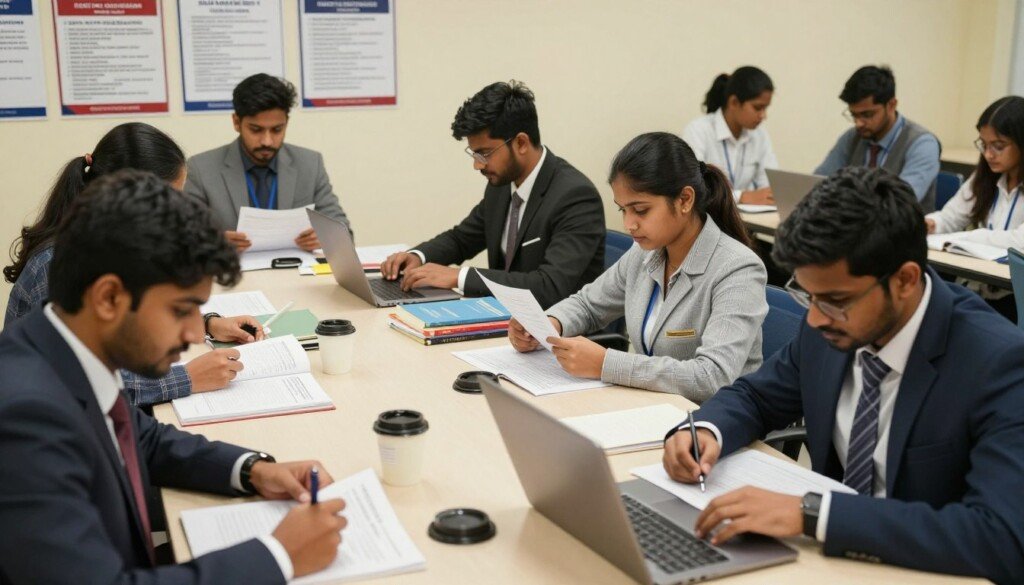
Step 2: Prepare Your Application and Documents
After passing the entrance exam, prepare your application and gather documents. This includes:
- Academic transcripts and certificates
- Work experience certificates
- Entrance exam scorecards
- Personal essays and statements of purpose
- Letters of recommendation
Make sure your application is well-written. It should highlight your strengths and achievements.
Step 3: Navigate Group Discussion and Personal Interview Rounds
The last stages are Group Discussions (GD) and Personal Interviews (PI). These test your communication, problem-solving, and personality.
To do well in GDs, focus on:
- Active listening and contributing to the discussion
- Sharing your knowledge on various topics
- Showing teamwork and leadership skills
For PIs, be ready to:
- Talk about your academic background and work experience
- Highlight your achievements and career goals
- Show your personality and fit for the program
By following these steps and preparing well, you can improve your chances of getting into a top MBA program in India.
MBA Fees, Salary Packages, and ROI Across Indian B-Schools
Thinking about an MBA in India? It’s key to know the costs and what you might earn back. MBA fees vary a lot between schools. Knowing these costs, average salaries, and top employers can guide your choice.
MBA Programme Fees at IIMs, FMS, and Private Institutions
MBA programme fees in India change a lot between IIMs, FMS, and private schools. Fees at top IIMs can be from ₹20 lakhs to over ₹25 lakhs for the whole course. Private schools might charge more, while FMS Delhi, funded by the government, might be cheaper.
Average Placement Packages by Specialisation and Institute
Salaries for MBA graduates in India depend on their specialisation and school. For example, MBA Finance graduates from top IIMs can earn ₹15 lakhs to ₹25 lakhs a year. Marketing graduates might get ₹10 lakhs to ₹20 lakhs annually. Schools like IIM Ahmedabad and IIM Bangalore often have high placement rates.
Top Recruiting Companies: TCS, Wipro, McKinsey, BCG, and More
Big names like TCS, Wipro, McKinsey, and BCG hire MBA graduates from Indian schools. They offer jobs in finance, marketing, operations, and consulting. Having these companies on campus boosts the MBA’s value.
Calculate Your Return on Investment Timeline
To figure out when your MBA will pay off, add up the costs. This includes tuition, living expenses, and what you could have earned instead. Then compare this to your expected salary and career growth. This will show you when your MBA investment will start to pay off.
How to Choose the Right MBA Specialisation for Your Career Goals
Your MBA specialisation can change your career path. It’s crucial to pick the right one. There are several steps to help you make the best choice.
Step 1: Evaluate Your Academic Background and Work Experience
Start by looking at your academic and work history. Your past education and work can guide your specialisation choice.
If you studied engineering, you might like specialisations like Operations or Supply Chain Management.
Step 2: Assess Your Strengths, Interests, and Personality Type
Know your strengths, interests, and personality. If you’re good at solving problems, Finance or Business Analytics might be for you.
If you prefer working with people, Human Resources or Marketing could be a better fit.
Step 3: Research Industry Trends and Job Market Demand in India
It’s important to check current industry trends and job demand. The Indian job market is always changing.
For example, data analysts and scientists are in high demand, making Business Analytics very popular.
Step 4: Consider Salary Expectations and Growth Potential
Think about salary and career growth. Different specialisations offer different pay.
Finance and Business Analytics often have higher starting salaries than other fields.
Step 5: Talk to Alumni and Industry Professionals
Talking to alumni and professionals can give you valuable insights. They can share their experiences and offer advice.
| Factor | Considerations |
|---|---|
| Academic Background | Relevance of undergraduate degree to MBA specialisation |
| Work Experience | Industry exposure and transferable skills |
| Personal Strengths and Interests | Alignment with specialisation requirements |
| Industry Trends | Growth prospects and demand in the job market |
| Salary Expectations | Average salary ranges for different specialisations |
By considering these factors, you can choose the right MBA specialisation for your career.
Conclusion
You now know a lot about MBA specializations and the jobs they lead to. With options like Finance, Marketing, Business Analytics, and Operations, an MBA boosts your career chances in many fields.
Thinking about your MBA? It’s key to get career advice tailored to you. Visit globalcareerlabs.com to see how they can guide you through the many MBA career paths.
Using sites like globalcareerlabs.com for career advice can really help. You’ll learn about your strengths and what you enjoy, leading to a rewarding career. Start your MBA journey and build a successful career now.
Frequently Asked Questions
What does the typical MBA admission process involve for Indian students?
How much are the average MBA fees in India across different tiers of colleges?
Which institutions consistently lead the MBA colleges ranking in the country?
What kind of MBA salary package can you expect as a fresher from a top B-school?
What are the most diverse MBA career options available to you after graduation?
How is the two-year MBA programme structured in India?
Why is an MBA considered a premier choice after you complete an engineering degree?
Ready to move forward in your studies and career?
Check out GlobalCareerLabs.com for tailored career advice. Their experts can guide you through the BBA course. They help you reach your highest potential.
Your future begins with making the right choice today. Start Now!
GlobalCareerLabs.com
Your Partner in Career Success
Related Resources:
– What to Do After 12th: Your Ultimate Guide to Successful Careers
– Courses After 12th: 100+ Best Options for Bright Future
– NEET Preparation 2026: Your Complete Strategy & Planning For Success
– JEE Main Preparation 2026: Proven Strategy for Sure Success
– Career Counselling in India: Complete Guide for Students
– Career Options After 10th: Successful Career Paths for Students
– Courses After 12th: 100+ Best Options for Bright Future
– What to Do After 12th: Your Ultimate Guide to Successful Careers
– Best Colleges in India: Your Complete Guide
– Sarkari Naukri: Complete Guide to Govt Jobs in India
– Best Career Options After 12th: Successful Careers for You
External Resources for You
- AICTE — MBA & PGDM Model Curriculum — All India Council for Technical Education, Government of India — Official model curriculum for MBA and PGDM programmes followed by AICTE-approved institutions across India
- IIM Ahmedabad — PGP Curriculum — Indian Institute of Management Ahmedabad — India’s premier B-school curriculum, widely referenced as the gold standard for MBA subject design
- UGC — University Grants Commission — Ministry of Education, Government of India — Statutory body governing MBA degree standards and university recognition across India
- CAT 2025 — IIM Official Portal — Indian Institutes of Management — Official gateway for MBA admissions to all IIMs and hundreds of top B-schools across India
Disclaimer:
Salary figures, course fees and other course details & career information provided in this article are for general reference only and may vary based on location, company, experience & market conditions. Readers are advised to independently verify all information from official and authentic sources before making any career or educational decisions. GlobalCareerLabs.com does not guarantee the accuracy or authenticity of this data. And so, Global Career Labs shall not be held responsible for any decisions made based on this information.
Related posts:
 Data Science Course After 12th: Best Options & Career Path
 Industrial Training: Importance, Types & How to Find One 2026
 BBA Course: Your Complete Guide – College List, Subjects, Fees & Career Options
 BBA 1st Year Subjects: Complete Syllabus & Subject List 2026
 Biotechnology Careers – Your Ultimate Guide to ₹10-30 Lakh Salaries
 Medical Courses After 12th Without NEET: 20+ Options 2026
 Best MBA Colleges in India 2026: Top 25 with Fees & ROI
 Career Options After 12th in India: Know How to take The Right Decision
 Overseas Education – Way to Successful Dollar Salary Jobs
 Best Career for Me: Complete Self-Discovery -Aptitude & Personality Tests
 Career Counsellors in Kolkata: Know The Best Experts 2006
 Free Online Aptitude Test For All – Students, Freshers & Professionals
 Diploma Courses After 10th: Complete List with Fees 2026
 Which Stream is Best After 10th? Science vs Commerce vs Arts
 Subject Combination in Class 10: Complete Guide for Students
 Psychometric Assessment Meaning: How It Helps Career Decisions
 Cybersecurity Jobs for Freshers: How to Get Hired 2026
 Career Counsellor: Your Complete Guide to Finding the Right Counsellor
 How to Become A Data Scientist in 2026 Without Coding Knowledge: Earn More than ₹10 LPA Salary
 Career Counsellor Certification: Ultimate Guide to becoming a successful Counsellor
Powered by YARPP.