
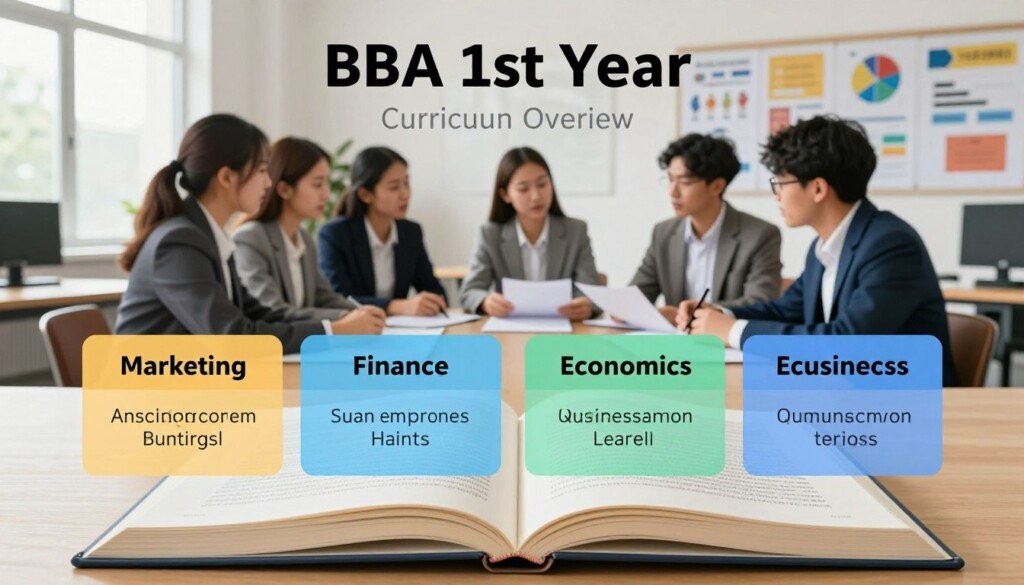
The first semester of a BBA feels very different from Class 12 — and most students aren’t quite prepared for that shift. School had a fixed timetable, fixed textbooks, and a syllabus you could see from one end to the other. College is less structured, and the subjects arrive all at once without much context. Understanding the BBA 1st year subjects before you actually sit in that first lecture makes a real difference — because you stop reacting and start preparing. The first year covers Financial Accounting, Business Economics, Principles of Management, Business Communication, and Business Law across two semesters, and each subject builds directly on the next.
What catches many students off guard is how interconnected these subjects are. Economics informs your understanding of marketing. Accounting connects directly to finance in Year 2. Communication skills underpin everything from presentations to group projects. Getting the first year right doesn’t just mean passing exams — it sets the pace and the mindset for the entire three-year programme.
This guide gives you a clear, semester-wise breakdown of every subject, what each one covers, and how to approach the year strategically.
What You Can Learn From This Article
- Complete BBA 1st year subjects list — Semester 1 and Semester 2 breakdown
- What each core subject covers and why it matters for your career
- How the 1st year syllabus connects to 2nd and 3rd year specialisations
- Top universities and their BBA curriculum comparisons for 2026
- Study tips and subject-wise preparation strategy for first-year students
Why BBA is Becoming India’s Preferred Management Course in 2026
BBA is now a top choice for Indian students. It teaches business administration well. This makes it great for those wanting to manage businesses.
The Rising Popularity of BBA Among Indian Students
The BBA program teaches business principles and management. It’s very popular among Indian students.
Its popularity comes from preparing students for the business world. A survey shows over 70% of Indian students see BBA as a good career choice.
BBA vs. Engineering and Medical: Understanding Your Career Options
Indian students often choose between BBA, engineering, and medical. Each field has its own benefits and career paths.
It’s important to know the differences. This helps students make the right choice for their future.
| Course | Typical Career Paths | Key Skills |
|---|---|---|
| BBA | Management, Marketing, Finance, HR | Leadership, Communication, Analytical |
| Engineering | Design, Development, Manufacturing | Technical, Problem-solving, Analytical |
| Medical | Healthcare, Research, Clinical Practice | Scientific, Compassionate, Detail-oriented |
How BBA Compares with Traditional Commerce Degrees
BBA and traditional commerce degrees are similar but different. BBA focuses on management and business. Traditional commerce degrees focus on finance and economics.
“BBA is a more holistic course that prepares students for various roles in the business world, whereas traditional commerce degrees provide a strong foundation in financial and economic principles.”
BBA offers more career options in management and administration. This makes it a better choice for many.
Complete Guide to BBA 1st Year Subjects
Starting your BBA journey means diving into a variety of subjects in your first year. The curriculum is made to give you a strong base in business administration. This prepares you for a successful career in the corporate world.
Core Management and Business Subjects
The core subjects of management and business are the heart of the BBA curriculum. They are key to grasping the principles and practices of business management.
Principles of Management
This subject teaches you the basics of management. You’ll learn about planning, organizing, staffing, directing, and controlling. You’ll also explore the evolution of management thought and the contributions of management theorists.
Business Organisation and Systems
You’ll study the different types of business organizations and their structures. This subject helps you understand how businesses work and the factors that affect their success.
Organisational Behaviour
Organisational behaviour looks at human behaviour in organizations. You’ll learn about individual and group dynamics, motivation, leadership, and communication. These are all crucial for effective management.
Economics and Accounting Foundations
Understanding economics and accounting is essential for any business professional. These subjects give you the tools to analyze business performance and make informed decisions.
Business Economics (Micro and Macro)
You’ll learn about both microeconomics and macroeconomics. Microeconomics looks at individual economic units, while macroeconomics looks at the economy as a whole. Knowing both is key for analyzing business environments.
Financial Accounting
Financial accounting teaches you how to prepare and interpret financial statements. This includes balance sheets, income statements, and cash flow statements. This skill is vital for assessing a company’s financial health.
Cost Accounting Basics
Cost accounting is important for understanding a business’s cost structure. You’ll learn how to classify, record, and report costs. You’ll also learn how to use this information for decision-making.
Quantitative and Analytical Subjects
Quantitative and analytical skills are highly valued in the business world. These subjects help you develop the ability to analyze data and make informed decisions.
Business Mathematics
Business mathematics covers various mathematical techniques used in business. This includes algebra, calculus, and financial mathematics. You’ll learn how to apply these techniques to solve business problems.
Business Statistics
Business statistics introduces you to data collection, analysis, and interpretation. You’ll learn how to use statistical tools to understand business trends and make predictions.
Communication and Essential Skills
BBA programs also focus on developing essential skills. This includes communication, computer applications, and environmental awareness.
Business Communication
Effective communication is critical in business. You’ll learn how to communicate clearly and professionally. This includes writing reports, making presentations, and participating in meetings.
Computer Applications for Business
This subject introduces you to computer applications used in business. This includes software for accounting, marketing, and data analysis. You’ll gain practical skills in using these tools.
Environmental Studies
Understanding the environmental impact of business activities is important. You’ll learn about environmental management and sustainability. You’ll also learn how businesses can adopt sustainable practices.
“The key to success in business is not just about understanding the technical aspects, but also about developing the right skills and attitude,” says a renowned business educator. By mastering the subjects covered in the BBA 1st year, you’ll be well on your way to achieving your career goals.
Semester-Wise Breakdown: What to Expect in Each Term
Starting your BBA journey means getting to know the semester-wise subjects. The BBA course spans six semesters, with the first year focusing on basics. Knowing what each term brings helps you prepare and make the most of your time.
BBA First Semester Subject Structure
In the first semester, you’ll learn the basics of business and management. You’ll study:
- Principles of Management
- Business Economics
- Financial Accounting
- Business Communication
- Business Mathematics and Statistics
These subjects are the foundation for understanding business operations and management principles.
BBA Second Semester Subject Structure
The second semester builds on the first. You’ll study subjects like:
- Organisational Behaviour
- Marketing Management
- Business Environment
- Business Law
- Computer Applications in Business
These subjects deepen your knowledge of business functions and prepare you for more complex studies.
Credit System and Assessment Pattern in Indian Universities
Indian universities like IPU and CCSU use a credit system. Each subject has a certain number of credits based on instruction hours. The assessment pattern includes internal assessments and end-term exams. It’s important to understand this system to manage your academic performance.
Key aspects of the credit system and assessment pattern:
- Credits are based on the course’s academic weightage
- Internal assessments include class participation, quizzes, and assignments
- End-term exams cover the whole syllabus
Internal Assessments vs. End-Term Examinations
Internal assessments and end-term exams are both crucial. Internal assessments keep you engaged, while end-term exams test your deep understanding of the subject.
Tips for excelling in both:
- Regularly attend classes and participate in discussions
- Keep up with assignments and quizzes
- Prepare well for end-term exams
Understanding the semester-wise breakdown and assessment patterns helps you navigate your BBA 1st year successfully.
Understanding Key BBA 1st Year Subjects in Detail
To do well in your BBA 1st year, it’s key to understand the main subjects. These subjects cover business basics, economic trends, finance, and communication.
Principles of Management: Building Your Leadership Foundation
The Principles of Management subject teaches you about management basics. It covers the five main functions: planning, organising, staffing, directing, and controlling. Knowing these is vital for becoming a leader.
Planning, Organising, Staffing, Directing, and Controlling
The five functions are the heart of management. Planning sets goals, while organising uses resources to reach them. Staffing is about hiring and keeping good people, directing guides them towards goals, and controlling checks if goals are met.
Companies like Tata Motors and Infosys show good management. They plan well, organise their teams, and control their work to stay ahead.
Management Theories and Indian Business Case Studies
Learning about management theories, like those by Henri Fayol and Frederick Taylor, gives insights into good management. Case studies from India, like Air India and Flipkart, show how these theories work in real life.

Business Economics: Analysing Market Dynamics
Business Economics is key for understanding markets, consumer behaviour, and the economic environment. It’s vital for businesses.
Demand and Supply in the Indian Economy
Demand and supply are basic to market understanding. In India, population, income, and government policies affect these.
The demand for electric vehicles in India is growing. This is due to government support and environmental awareness.
Understanding GDP, Inflation, and Fiscal Policies
Macroeconomic indicators like GDP, inflation, and fiscal policies are important for businesses. They help make informed decisions.
India’s economic growth, inflation, and policies impact business strategies. BBA students need to understand these.
Financial Accounting: The Language of Business
Financial Accounting is crucial. It teaches how to record, classify, and report financial activities.
Journal Entries, Ledgers, and Trial Balance
Knowing how to make journal entries, keep ledgers, and balance them is key. These skills are vital for accurate financial reports and following rules.
Preparing Financial Statements for Indian Companies
Financial statements, like balance sheets and profit and loss accounts, are important. They help stakeholders see a company’s financial health.
Companies like Tata Steel and Reliance Industries follow Indian Accounting Standards (Ind AS) for these statements.
Business Communication: Mastering Professional Skills
Good business communication is essential for success.
Written Communication: Reports, Emails, and Proposals
Being good at written communication, like reports and proposals, is crucial. It helps share ideas clearly.
A well-written proposal can greatly help in getting a deal or project.
Presentation Skills and Group Discussions
Oral communication skills, including presentations and group discussions, are vital. They are tested in BBA programs.
These skills are important for professional success. They are often assessed in BBA programs.
How to Excel in Your BBA 1st Year: Step-by-Step Preparation Guide
Your BBA 1st year is key to your future success. To excel, you need to focus on studying hard, getting practical experience, and planning well. By following a clear plan, you can do well in your studies and set a strong base for your management career.
Master Your Syllabus from Day One
Knowing your syllabus early is vital. It helps you plan your study time well and get ready for exams. Break down the syllabus into smaller parts and set aside specific times for each subject. This way, you can keep up with your work and avoid last-minute stress.
Develop a Consistent Study Routine
Being consistent is crucial for success. Make a regular study routine that fits your learning style and stick to it. Set aside time each day for studying and review what you’ve learned often. This habit will improve your understanding and help you remember things better.
Focus on Practical Applications and Case Studies
BBA is not just about theory; it’s about applying what you learn in real life. Get involved with case studies and join discussions on practical uses of what you’re learning. This will deepen your understanding and boost your problem-solving skills.
Join Student Clubs and Business Societies
Being in student clubs and business societies can greatly enhance your BBA experience. These groups offer chances to develop leadership skills, network with others, and explore different business areas. Find clubs that match your interests and career goals, and get involved.
Build Industry Awareness Through Internships
Internships give you hands-on experience and insight into the industry. They’re a great way to use what you learn in real situations and build professional contacts. Start looking for internships early and make the most of them to gain practical experience.
Leverage Online Resources and Business Journals
Keeping up with the latest business news is important for BBA students. Use online resources like business journals, blogs, and news sites to learn more and stay updated. This will improve your studies and make you more aware of the business world.
Prepare for Internal Assessments Strategically
Internal assessments are a big part of your BBA journey. Prepare for them well by understanding the format, managing your time, and focusing on key areas. Regularly check how you’re doing and adjust your study plan as needed to stay on track.
By following these steps, you can succeed in your BBA 1st year and beyond. For tailored career advice and to explore BBA career options, check out GlobalCareerLabs.com.
BBA Course Fees and Top Colleges in India for 2026
If you’re thinking about a BBA in 2026, knowing the fees and top colleges in India is key. It helps you make a smart choice.
Top BBA Colleges: Shaheed Sukhdev College of Business Studies, Christ University, and Symbiosis
India has many top schools for BBA programs. Some of the best include:
- Shaheed Sukhdev College of Business Studies: Known for its tough academic program and great job placements.
- Christ University: Offers a full BBA program with a focus on all-around education.
- Symbiosis: Provides a diverse and welcoming place for BBA students, with a big focus on extra activities.
IIM Indore’s Integrated Programme in Management (IPM)
IIM Indore’s IPM is a special five-year program. It mixes undergraduate and postgraduate management education. This program is very competitive and gives a full management education.
Expected Course Fees Across Different Institutions
BBA program fees in India vary a lot between different schools.
Government Colleges: ₹50,000 to ₹2 Lakhs per Year
Government colleges have affordable BBA programs. Fees are between ₹50,000 to ₹2 Lakhs a year. These schools are popular for their quality and lower costs.
Private Universities: ₹2 Lakhs to ₹8 Lakhs per Year
Private universities in India charge more for BBA programs. Fees are between ₹2 Lakhs to ₹8 Lakhs a year. They often have better facilities and job chances than government colleges.
Premier Institutes: ₹8 Lakhs to ₹15 Lakhs for the Entire Programme
Premier schools like IIM Indore’s IPM program cost more. Fees are from ₹8 Lakhs to ₹15 Lakhs for the whole program. These schools offer top education and great career chances.
Here’s a quick look at the expected fees for different types of schools:
| Institution Type | Fee Range (per year) | Total Fee (approximate) |
|---|---|---|
| Government Colleges | ₹50,000 – ₹2 Lakhs | ₹1.5 Lakhs – ₹6 Lakhs |
| Private Universities | ₹2 Lakhs – ₹8 Lakhs | ₹6 Lakhs – ₹24 Lakhs |
| Premier Institutes | – | ₹8 Lakhs – ₹15 Lakhs |

When picking a BBA program, think about more than just the fees. Look at the education quality, facilities, and job chances too.
BBA Admission 2026: Entrance Exams You Need to Know
The journey to BBA admission 2026 starts with passing the right entrance exams. It’s key to know the exams needed by different schools across India.
IPMAT (IIM Indore Integrated Programme in Management Aptitude Test)
The IPMAT is a tough exam by IIM Indore for its management program. It checks your skills in verbal, quantitative, and logical reasoning. To do well, focus on quantitative aptitude and verbal ability.
NPAT (NMIMS Programmes After Twelfth)
NPAT is for NMIMS University. It tests your skills in mathematics, language skills, and logical reasoning. Knowing the exam pattern and syllabus is key to success.
DU JAT (Delhi University Joint Admission Test)
DU JAT is for Delhi University’s management programs. It checks your aptitude in business and general awareness, logical reasoning, and quantitative aptitude. A good study plan is essential.
SET (Symbiosis Entrance Test)
SET is for Symbiosis International University. It tests English, quantitative, analytical, and general awareness skills. Practice mock tests and focus on time management to do well.
Christ University Entrance Test
Christ University has its own BBA entrance test. It checks English, quantitative, and logical reasoning skills. Knowing the exam pattern and syllabus is crucial for preparation.
State-Level and University-Specific Entrance Exams
There are also state-level and university-specific exams for BBA admissions. It’s important to research the specific needs of the universities you’re applying to and prepare well.
Important Dates and Application Deadlines for 2026
It’s vital to keep track of important dates and application deadlines for a smooth process. Make sure to note the following dates:
- Release of application forms
- Last date for submitting applications
- Entrance exam dates
- Declaration of results
- Counselling and interview dates
Being organised will help you manage your time well and avoid last-minute stress.
Skills You’ll Develop in BBA 1st Year
The BBA first year focuses on giving you key skills needed in business. You’ll learn to analyze, manage finances, communicate well, and solve problems. These skills are vital in the business world.
Analytical and Critical Thinking Abilities
In your BBA first year, you’ll get better at analyzing and thinking critically. Subjects like Business Economics and Principles of Management help a lot. These skills help you understand markets, consumer behavior, and make smart business choices.
For example, knowing how economic policies affect businesses is crucial. You’ll learn this through case studies and projects.
Financial Literacy and Numerical Aptitude
You’ll also improve your financial knowledge and math skills. Financial Accounting and other math subjects are key. They help you read financial statements, manage budgets, and analyze data.
Companies like Infosys and TCS value financial literacy a lot when hiring BBA graduates.
Communication and Interpersonal Skills
Good communication and teamwork skills are essential in business. Business Communication subjects teach you to share ideas, negotiate, and work in teams.
These skills are important for managing projects and building client relationships.
Problem-Solving and Decision-Making Capabilities
The BBA curriculum boosts your problem-solving and decision-making skills. You’ll learn from case studies and group discussions. This helps you analyze problems, find solutions, and make informed choices.
This skill is very useful in retail and marketing, where being adaptable and making quick decisions is important.
Digital Literacy and Technology Integration
In today’s world, knowing technology is crucial. Your BBA program will teach you about business software and tools. This improves your digital skills.
Knowing how to use technology for business, data analysis, and digital marketing makes you valuable to any company.
| Skill Developed | Relevance in Indian Business Context |
|---|---|
| Analytical and Critical Thinking | Essential for market analysis and business strategy development in companies like Reliance Industries. |
| Financial Literacy and Numerical Aptitude | Crucial for financial management in banks and financial institutions like HDFC Bank. |
| Communication and Interpersonal Skills | Vital for client management and team collaboration in IT companies like Wipro. |
| Problem-Solving and Decision-Making | Important for operational management in manufacturing companies like Tata Motors. |
| Digital Literacy and Technology Integration | Necessary for digital marketing and e-commerce businesses like Flipkart. |
By getting these skills, you’ll become more employable. The BBA first year is a key step towards a successful business career.
Career Prospects and Salary Expectations After BBA
When you finish your BBA, you’ll find many job opportunities. The skills and knowledge you’ve gained are useful in different industries.
Entry-Level Positions in Top Indian Companies
Top Indian companies have entry-level jobs for BBA graduates. These roles help you grow your skills and get industry experience.
Management Trainee Roles at Reliance, Tata, and Aditya Birla Group
Reliance, Tata, and Aditya Birla Group offer management trainee programs. These programs aim to turn fresh graduates into future leaders.
Marketing and Sales Positions in FMCG Sector
The FMCG sector also hires BBA graduates. It offers many marketing and sales roles.
Banking and Financial Services Opportunities
BBA graduates can find jobs in banking and financial services. Many banks and financial institutions look for BBA graduates for various roles.
Expected Starting Salaries for BBA Graduates
The starting salary for BBA graduates varies. It depends on the company, location, and industry. Here’s a general idea of what you can expect.
Government Sector: ₹3 to ₹5 Lakhs per Annum
Government jobs usually pay between ₹3 to ₹5 lakhs per year. These jobs often come with extra benefits and job security.
Private Sector: ₹3.5 to ₹7 Lakhs per Annum
In the private sector, BBA graduates can earn between ₹3.5 to ₹7 lakhs per year. The salary depends on the company’s size and industry.
MNCs and Top Companies: ₹6 to ₹12 Lakhs per Annum
Multinational corporations and top Indian companies offer higher salaries. They pay between ₹6 to ₹12 lakhs per year.
Further Education Options: MBA, CA, CS, and Specialised Certifications
After your BBA, you might want to get more education. You can pursue an MBA, CA, CS, or specialised certifications.
Entrepreneurship Opportunities for BBA Graduates
BBA graduates can also think about starting their own business. With the right skills and knowledge, you can create your own opportunities.
Conclusion
Understanding the BBA curriculum and career prospects helps you make smart choices. The BBA course gives you a solid base in management, business economics, and finance. This prepares you for a successful career in many fields.
As you go through your BBA, getting career guidance is key. It helps you use your opportunities well. With the right advice, you can do well in your studies and find a great job.
For personal career advice and to find the best jobs for you, check out GlobalCareerLabs.com. Start your journey to a fulfilling career by making informed choices today.
Frequently Asked Questions
What are the core BBA subjects I will study in my first year?
What is the average BBA course fees in India for 2026?
When should I start preparing for BBA admission 2026?
What are the primary BBA career options available after graduation?
What can I expect as a BBA salary in india for a fresher?
Are internships mandatory during the BBA course?
Can I pursue an MBA immediately after my BBA?
Your future begins with making the right choice today. Start Now!
GlobalCareerLabs.com
Your Partner in Career Success
Related Resources:
– What to Do After 12th: Your Ultimate Guide to Successful Careers
– Courses After 12th: 100+ Best Options for Bright Future
– NEET Preparation 2026: Your Complete Strategy & Planning For Success
– JEE Main Preparation 2026: Proven Strategy for Sure Success
– Career Counselling in India: Complete Guide for Students
– Career Options After 10th: Successful Career Paths for Students
– Courses After 12th: 100+ Best Options for Bright Future
– What to Do After 12th: Your Ultimate Guide to Successful Careers
– Best Colleges in India: Your Complete Guide
– Sarkari Naukri: Complete Guide to Govt Jobs in India
– Best Career Options After 12th: Successful Careers for You
– Best Fashion Design Careers in India: Your Ultimate Guide
External Resources for You
- University Grants Commission — UGC — Ministry of Education, Government of India — Statutory body regulating BBA programmes and university standards across India
- AICTE — All India Council for Technical Education — Statutory body approving management and technical undergraduate programmes including BBA
- NIRF 2024 Management Rankings — National Institutional Ranking Framework, Ministry of Education — Official rankings of top BBA and management colleges in India
- CUET UG 2026 — NTA Official Portal — National Testing Agency — Primary entrance exam for BBA admissions at central and many state universities in 2026
Disclaimer:
Salary figures, course fees and other course details & career information provided in this article are for general reference only and may vary based on location, company, experience & market conditions. Readers are advised to independently verify all information from official and authentic sources before making any career or educational decisions. GlobalCareerLabs.com does not guarantee the accuracy or authenticity of this data. And so, Global Career Labs shall not be held responsible for any decisions made based on this information.
Related posts:
 BBA Course: Your Complete Guide – College List, Subjects, Fees & Career Options
 Medical Courses After 12th Without NEET: 20+ Options 2026
 Industrial Training: Importance, Types & How to Find One 2026
 Data Science Course After 12th: Best Options & Career Path
 Career Aptitude Test: Choose Your Right Career Path Now in 2026
 Bio Courses After 12th: Best Options Beyond MBBS & NEET 2026
 Diploma Courses After 10th: Complete List with Fees 2026
 Career Options After 12th in India: Know How to take The Right Decision
 Career Counselling After 12th: Ultimate Guide for Career Planning
 Which Career Is Best for Me: Ultimate Guide to “Best Careers”
 Career Counselling Near Me: Find The Best Career Counsellor
 Best Career for Me: Complete Self-Discovery -Aptitude & Personality Tests
 Career Counsellors in Kolkata: Know The Best Experts 2006
 Biotechnology Careers – Your Ultimate Guide to ₹10-30 Lakh Salaries
 BBA Subjects List: Year-wise Syllabus & Core Subjects in BBA 2026
 Career Opportunities After 12th: Complete Guide for Students 2026
 Which Stream is Best After 10th? Science vs Commerce vs Arts
 Career Guidance: Complete Roadmap to Find Your Dream Job in 2026
 Professional Courses After 12th: Best Courses for High Salary Careers
 Non Medical Subjects in 11th Class: Complete List 2026
Powered by YARPP.