

Class 10th feels manageable because you’re still studying everything. Then the board exams end, and suddenly everyone has an opinion about what you should do next. The real decision staring at you is your subject combination in 10th — Science with Maths, Science with Biology, Commerce, or Arts — and it quietly determines which entrance exams you’ll qualify for, which careers stay open, and which ones close. It’s not dramatic, but it is consequential.
Most students are making this choice at 15 or 16, before they’ve had any real exposure to what these subjects actually lead to. You might love Physics without knowing if you’d enjoy engineering as a profession. You might be good at accounts without knowing if CA suits your temperament. The subject choice isn’t the problem — the lack of information around it is.
This guide fixes that. Whether you’re a student trying to figure out what genuinely interests you, or a parent trying to give useful advice without projecting your own preferences — you’ll find clear, honest answers here.
What This Article Covers
- Why your subject combination in Class 10 matters more than most people realise
- A clear breakdown of Science, Commerce, and Arts — what each opens and closes
- How to assess your strengths honestly, beyond just board exam marks
- Common mistakes students make when choosing, and how to avoid them
- How career counselling can bring clarity when the options feel overwhelming
Why Your Subject Combination in 10th Matters for Your Future
Your choices in Class 10 can shape your future studies. These choices are key to your academic and career paths. They decide what streams you can take in Classes 11 and 12.
In India, you have three main paths after Class 10: Science, Commerce, and Humanities. Each path leads to different careers. For example, Science can lead to top tech schools like IITs and NITs through JEE exams. It also opens doors to medical careers through NEET.
The Impact of Stream Selection on Career Opportunities
Choosing the right stream is vital for your career. For instance, Science with PCM (Physics, Chemistry, and Mathematics) leads to engineering. Science with PCB (Physics, Chemistry, and Biology) is for medical fields.
The Commerce stream is best for business and finance. It prepares you for careers like Chartered Accountancy and MBA. Humanities offers paths in social sciences, law, and journalism, leading to UPSC exams.
| Stream | Popular Subjects | Career Opportunities |
|---|---|---|
| Science | PCM, PCB | Engineering, Medical, Research |
| Commerce | Accountancy, Business Studies, Economics | CA, CS, MBA, Banking, Finance |
| Humanities | History, Geography, Political Science | Civil Services, Law, Journalism, Teaching |
Understanding the Indian Education System’s Structure
The Indian education system is set up so that your Class 10 choices shape your future. Knowing this helps you make a smart choice.
After Class 10, you pick a stream based on your career dreams. Classes 11 and 12 are key as they prepare you for exams and set your career path.
Understanding your Class 10 choices helps you make a choice that fits your goals. It’s important to think about your interests, strengths, and career dreams before deciding.
Understanding the Three Main Streams After Class 10
The Indian education system has three main streams after Class 10. Each stream has its own subject mix and career paths. Knowing about these streams is key to choosing the right path for your future.
PCM and PCB Combinations in Science Stream
The Science stream is a favourite among students. It offers two main paths: PCM (Physics, Chemistry, and Mathematics) and PCB (Physics, Chemistry, and Biology).
- PCM: Great for those wanting to study engineering, architecture, or technical fields. Maths and Physics are crucial for exams like JEE Main and JEE Advanced.
- PCB: Best for students aiming at medicine, biotechnology, or biological sciences. It prepares you for NEET and other medical entrance tests.
Commerce Stream: With and Without Maths
The Commerce stream is for students interested in business, finance, and economics. It allows flexibility, with or without Maths.
- Commerce with Maths: Good for students planning to become CA, CS, or CMA. It also helps in quantitative finance or business analytics.
- Commerce without Maths: Ideal for those focusing on business studies, economics, and accountancy. No need for advanced maths skills.
Diverse Subject Options in Humanities and Arts Stream
The Humanities and Arts stream offers a wide range of subjects. This includes languages, history, geography, psychology, and sociology. It’s perfect for students interested in social sciences, humanities, or creative fields.
Key subjects in Humanities include:
- Languages (English, Hindi, or other regional languages)
- History and Culture
- Geography
- Psychology and Sociology
Understanding the subjects and career options in each stream helps you make a better choice. This choice should match your interests and strengths.
How to Assess Your Interests and Strengths
After finishing Class 10, you face a big choice. You need to pick subjects that match your career dreams. It’s key to know your interests, strengths, and future career goals.
Identifying Your Natural Aptitudes and Abilities
Start by thinking about what you naturally do well. What subjects do you like learning about? Where do you do best in school? Look back at your Class 9 and 10 grades. Your best subjects might show what stream you’re suited for.
If you’re good at solving problems and like math, you might want to choose the Science stream. This is because it includes subjects like Physics, Chemistry, and Mathematics.
Evaluating Your Class 10 Academic Performance
Your Class 10 grades show your strengths in different subjects. Look at your marks and see patterns. Did you do well in science or languages and social sciences? This helps you see where you’re strong.
Use the table below to evaluate your performance:
| Subject | Class 9 Marks | Class 10 Marks |
|---|---|---|
| Mathematics | 85 | 90 |
| Science | 80 | 88 |
| English | 75 | 78 |
| Social Science | 78 | 82 |
Considering Your Long-Term Career Aspirations
Think about your future career when choosing a stream. Look into different careers and what they need. For example, to be an engineer, you need to choose the Science stream with PCM.
For good advice, talk to career counsellors or experts in your dream field. They can guide you to the right career path based on your interests and strengths.
For more help, visit GlobalCareerLabs.com for expert career counselling.
Science Stream: Career Paths and Entrance Exams
Choosing the Science stream opens doors to many career paths. It’s key to know the entrance exams needed for success. This stream leads to fields like engineering, medicine, and pure sciences.
Engineering Route: JEE Main, JEE Advanced, and Admissions to IITs and NITs
The engineering path is very popular for Science stream students. To get into engineering, you must pass JEE Main and JEE Advanced. These exams lead to top institutions like Indian Institutes of Technology (IITs) and National Institutes of Technology (NITs).
Here’s a quick look at the engineering entrance exams:
| Exam Name | Purpose | Institutes |
|---|---|---|
| JEE Main | Qualifying exam for JEE Advanced and admissions to NITs | NITs, IIITs |
| JEE Advanced | Admissions to IITs | IITs |
Medical Route: NEET Examination and Top Medical Colleges
For those aiming for medicine, passing the National Eligibility cum Entrance Test (NEET) is crucial. NEET is the key exam for getting into top medical colleges in India.
Some leading medical colleges include:
- All India Institute of Medical Sciences (AIIMS)
- Postgraduate Institute of Medical Education and Research (PGIMER)
- Christian Medical College (CMC)
Pure Sciences and Research Opportunities in India
The Science stream also offers chances in pure sciences and research. Students can find careers in research, universities, and government bodies.
Expected Salary Packages in Science Fields Across Indian Companies
Science stream graduates can look forward to good salaries. Here’s a rough idea of what you might earn:
| Field | Average Salary Range (INR) |
|---|---|
| Engineering | 4-8 lakhs per annum |
| Medical | 6-15 lakhs per annum |
| Research | 3-6 lakhs per annum |
These figures are just estimates. Salaries can change based on many factors like location and industry.
Commerce Stream: Opportunities and Professional Courses
The Commerce stream is a key to the business and finance world. It offers many paths for students to find successful careers. When picking your class 11 subjects, it’s key to see the wide range of options this stream has.
Chartered Accountancy, Company Secretary, and Cost Accountancy Paths
Becoming a Chartered Accountant (CA) is a top choice in Commerce. The CA job is respected and requires hard work and exams by the Institute of Chartered Accountants of India (ICAI). The Company Secretary (CS) and Cost Accountancy paths are also valued, with the CS course run by the Institute of Company Secretaries of India (ICSI) and Cost Accountancy by the Institute of Cost Accountants of India (ICMAI).
These courses lead to promising careers and the chance to work with big companies. A CA can start with a salary of ₹6 lakhs to ₹10 lakhs a year, based on their exam results and the company they join.
Business Management, MBA Routes, and Top B-Schools
Business Management, like an MBA, is another great choice for Commerce students. Top B-Schools in India, like the Indian Institutes of Management (IIMs), provide excellent education and job chances. An MBA from a well-known school can lead to jobs paying ₹15 lakhs to ₹25 lakhs a year for new graduates.
The Commerce stream also offers chances in Finance, Marketing, and Human Resources. Students can pick a field that fits their interests and skills.
Banking, Finance, Economics, and Commerce Graduate Careers
Commerce graduates can find jobs in Banking and Finance, from investment banking to financial analysis. The Indian banking sector, with big banks like State Bank of India and private banks like HDFC and ICICI, has many chances. Careers in economics, in both the public and private sectors, are also options, with roles in policy-making, research, and analysis.
Also, Commerce graduates can start working in accounting, auditing, and financial management in various companies.
Expected Earnings in Commerce Professions in Indian Market
The pay in Commerce jobs varies by career path. For example, a CA or CS can earn a lot, as mentioned before. MBA graduates from top B-Schools also get high salaries. Even at the start, Commerce graduates can earn competitive salaries, from ₹3 lakhs to ₹6 lakhs a year, based on the job and company.
In summary, the Commerce stream has many rewarding and challenging career paths. By choosing the right career after 10th, you can start a successful journey in business and finance.
Humanities Stream: Diverse Career Possibilities
Humanities students have many career paths to choose from. They can work in civil services, media, and more. The skills they learn help them in many jobs, making them versatile.
Civil Services: UPSC, State PSC Examinations, and Administrative Roles
Working in civil services is a top choice for Humanities students. The UPSC exam can lead to being an IAS, IPS, or IFS officer. State PSC exams offer similar chances at the state level. These jobs include managing, making policies, and helping the nation.
To do well in civil services, you need:
- A deep understanding of social, political, and economic issues
- Great analytical and problem-solving skills
- Good communication and leadership skills
Law, Journalism, Mass Communication, and Media Careers
Humanities also leads to careers in law, journalism, and media. You can study law through exams like CLAT or LSAT. This can lead to jobs in legal practice, judiciary, or corporate law. Journalism and mass communication involve reporting, editing, and broadcasting news, with chances in print, digital, and electronic media.
Key skills for these careers include:
- Strong writing and reporting skills
- Ethical judgment and research skills
- Understanding of legal and social issues

Social Sciences, Psychology, Teaching, and Public Policy
Humanities students can also work in social sciences, psychology, teaching, and public policy. These fields involve research, analysis, and policy-making that affects society. Teaching is another rewarding job, where you can inspire and educate future generations.
To excel in these areas, focus on:
- Developing research and analytical skills
- Understanding human behavior and social dynamics
- Cultivating patience and effective communication
Career Growth and Salary Expectations in Humanities Fields
Career growth in Humanities fields is significant, with chances for advancement in many sectors. Salaries vary widely based on the career and industry. For example, civil servants and lawyers can earn good salaries, while journalists and teachers may start with lower salaries but can increase with experience.
Some approximate starting salary ranges in India are:
| Career Path | Starting Salary Range (INR) |
|---|---|
| Civil Services (IAS/IPS) | 56,100 – 1,77,500 per month |
| Law | 30,000 – 60,000 per month |
| Journalism/Media | 20,000 – 40,000 per month |
| Teaching | 25,000 – 50,000 per month |
In conclusion, Humanities offers a wide range of career options. By understanding your strengths and interests, you can find a fulfilling career path.
Common Mistakes Students Make When Choosing Streams
Choosing the right stream in Class 11 is a big decision. It affects the subjects you study and your future career. Think carefully before making your choice.
Students often face a tough decision when picking a stream. Some know what they want, but others are influenced by others. Mark Zuckerberg said, “The biggest risk is not taking any risk…” But in stream selection, making an informed choice is key.
Following Friends Without Proper Self-Assessment
Choosing a stream just because your friends do is a common mistake. It’s important to think about your own strengths and career goals. Career counselling can help you understand your abilities and make the right choice.
For example, if you like science but choose commerce because your friends do, you might struggle. But if you really want a certain stream, you’ll work harder and do better.
Succumbing to Parental Pressure Over Personal Interest
Another mistake is letting parents decide for you without listening to your own interests. Parents want the best for you, but they might not know what you want. It’s important to talk to your parents about your goals.
“The way to get started is to quit talking and begin doing.” – Walt Disney
This quote shows the value of making your own decisions. Don’t just follow others’ advice.
Believing in Misconceptions About Stream Hierarchy and Prestige
Many think some streams are better than others. For example, some believe science is more prestigious than humanities. But each stream has its own value and can lead to good careers.
Learning about the different career paths in each stream can clear up these misconceptions. Humanities, for example, can lead to careers in law, journalism, and social sciences.
Step-by-Step Guide to Making Your Final Decision
Choosing a stream after Class 10 can seem tough. But, with a clear guide, you can make a smart choice. Follow a step-by-step guide that looks at your interests, strengths, and career dreams.
Listing Your Top Three Career Interests and Goals
Start by listing your top three career interests and goals. Think about what subjects you love most and what careers match those subjects. For example, if you love science and solving problems, engineering or research might be for you.
Ask yourself these questions to narrow down your choices:
- Favourite subjects in school
- Activities do you enjoy in your free time
- Long-term career dreams
Researching Required Qualifications and Educational Paths
After finding your career interests, look into the qualifications and paths needed. Understand the subjects you’ll study in Class 11 and 12. Also, learn about the undergraduate and postgraduate courses for your desired career.
For instance, to become a doctor, choose the Science stream with PCB in Class 11 and 12. Then, you’ll need to pass the NEET exam.
| Career Aspiration | Stream | Class 11-12 Subjects | Entrance Exams |
|---|---|---|---|
| Engineering | Science | PCM (Physics, Chemistry, Mathematics) | JEE Main, JEE Advanced |
| Medical | Science | PCB (Physics, Chemistry, Biology) | NEET |
| Chartered Accountant | Commerce | Commerce with Mathematics | CA Foundation |
Consulting Teachers, Career Counsellors, and Working Professionals
Talking to teachers, career counsellors, and professionals can give you great insights. They can share their experience and industry knowledge to guide you.
“The best way to get good ideas is to get a lot of ideas.” – Linus Pauling
Getting advice from experts can help you understand different careers. This way, you can make a more informed choice.
Considering Backup Options and Future Flexibility
It’s also important to think about backup options and future flexibility. Your chosen stream should not limit your future. For example, Science stream students can explore careers in management or civil services with the right qualifications.
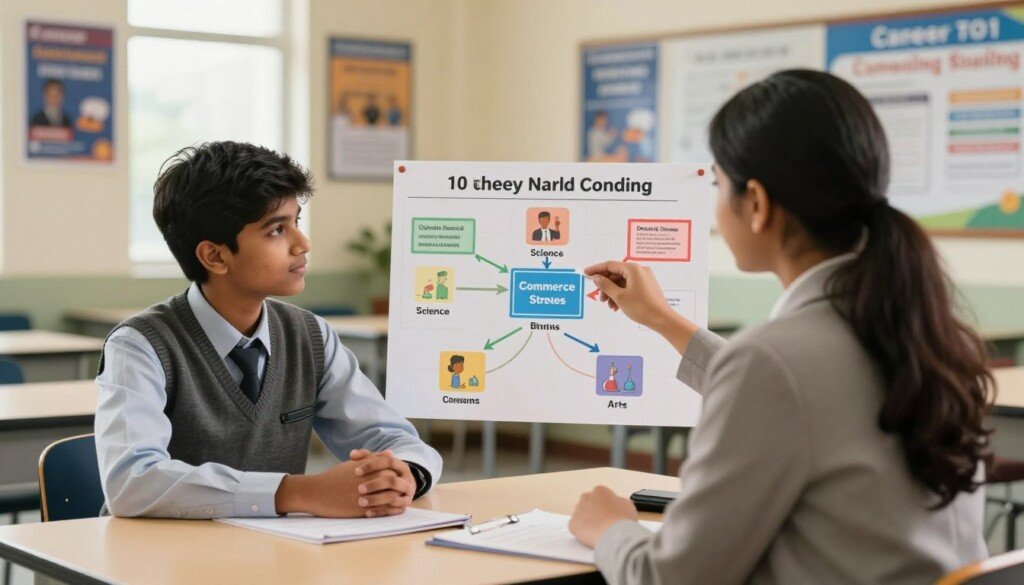
By following these steps, you can make a well-informed decision about your subject combination after Class 10. For personalised career counselling and guidance, visit GlobalCareerLabs.com.
Conclusion
Choosing the right subjects in Class 10 is a big decision. It can really affect your future career. You should pick subjects that match your interests, strengths, and goals.
Knowing how your subject choices can impact your future is key. Career counselling can guide you to make the best choice. GlobalCareerLabs.com provides detailed career counselling to help you find your path.
Start your journey to a rewarding career with GlobalCareerLabs.com. They offer the help and advice you need. With their support, you can reach your dreams.
FAQ
How do I decide which stream is best for my career after 10th?
What are the primary differences in the science vs commerce debate?
Which class 11 subjects are mandatory for someone aiming for the UPSC Civil Services?
Is it possible to pursue an MBA if I choose the Science stream in Class 11 and 12?
Why should I consider professional career counselling before selecting my stream?
Do I need Mathematics in Class 11 to succeed in the Commerce stream?
What are the career prospects for a student choosing the Humanities stream?
Your future begins with making the right choice today. Start Now!
GlobalCareerLabs.com
Your Partner in Career Success
Related Resources:
– Career Options After 10th: Successful Career Paths for Students
– What to Do After 12th: Your Ultimate Guide to Successful Careers
– Courses After 12th: 100+ Best Options for Bright Future
– NEET Preparation 2026: Your Complete Strategy & Planning For Success
– JEE Main Preparation 2026: Proven Strategy for Sure Success
– Career Counselling in India: Complete Guide for Students
– Career Options After 10th: Successful Career Paths for Students
– Courses After 12th: 100+ Best Options for Bright Future
– What to Do After 12th: Your Ultimate Guide to Successful Careers
– Best Colleges in India: Your Complete Guide
External Resources for You
(Please click the blue links)
- CBSE Academic Portal — Central Board of Secondary Education
- CBSE Senior Secondary Curriculum 2025-26 — Ministry of Education, Government of India
- JEE Main 2026 — National Testing Agency (NTA)
- NEET UG 2026 — National Testing Agency (NTA)
Disclaimer:
Salary figures, course fees and other course details & career information provided in this article are for general reference only and may vary based on location, company, experience & market conditions. Readers are advised to independently verify all information from official and authentic sources before making any career or educational decisions. Global Career Labs shall not be held responsible for any decisions made based on the information given in this Article.
Related posts:
 Free Online Aptitude Test For All – Students, Freshers & Professionals
 BBA 1st Year Subjects: Complete Syllabus & Subject List 2026
 Diploma Courses After 10th: Complete List with Fees 2026
 Which Stream is Best After 10th? Science vs Commerce vs Arts
 Career Confusion in Children: Causes, Effects And “How to Get Clarity”
 Career Counsellors in Kolkata: Know The Best Experts 2006
 What is BBA? Full Form, Eligibility, Syllabus & Career Options
 Medical Courses After 12th Without NEET: 20+ Options 2026
 Industrial Training: Importance, Types & How to Find One 2026
 BBA Course: Your Complete Guide – College List, Subjects, Fees & Career Options
 Data Science Course After 12th: Best Options & Career Path
 Career Aptitude Test: Choose Your Right Career Path Now in 2026
 Career Guidance After 10th: Your Complete Success Roadmap
 Best Career for Me: Complete Self-Discovery -Aptitude & Personality Tests
 Best Courses After 12th Commerce: Complete Guide 2026
 Paramedical Courses After 12th: Complete List with Fees 2026
 MBA Subjects List: Specialization-wise Syllabus Guide 2026
 Best MBA Colleges in India 2026: Top 25 with Fees & ROI
 Central Government Jobs: Your Ultimate Career Guide for 2026
 Best Stream After 10th: Plan your next move now
Powered by YARPP.