

Let’s be honest for a moment! You finished your 12th exams. Everyone around you — relatives, neighbours, your parents’ WhatsApp groups — is already deciding your future. “Doctor bano. Engineer bano.” And somewhere in all that noise, what you actually want is getting lost. If you’ve ever felt drawn to understanding people — why they think, feel, and behave the way they do — then psychology courses after 12th might be the career that was always meant for you. You just didn’t have a name for it yet.
Have you ever been the person your friends come to when they’re upset? The one who just gets people — who understands why someone is hurting even before they say a word? That’s not a coincidence. That’s a calling.
India is waking up to mental health like never before. Schools, hospitals, corporates, startups — everyone is desperately looking for people who understand the human mind. And students who choose this path today are stepping into a field that is just beginning to boom.
We’re talking about real careers. Real salaries — ₹4 to ₹8 lakhs to start, going much higher with experience. Real impact on real lives.
This guide is your complete roadmap — best courses, top colleges, career options, and salaries for 2026. No jargon. No confusion. Just everything you need to make a confident decision.
Ready? Let’s dive in.
Key Takeaways
- More people are interested in human behaviour, opening up many career paths across India.
- Students are now choosing social science paths over the usual NEET and JEE routes.
- Top Indian colleges offer special training for roles in mental health and counselling.
- Starting salaries in this field can reach several lakhs (₹) annually in the private sector.
- These qualifications are highly valued by major Indian companies and are a strong base for the UPSC.
Why Psychology is a Rewarding Career Choice in India
If you’re looking for a career that’s both fulfilling and helps others, psychology might be for you.
Psychology is becoming more popular in India. This is because more people are aware of mental health, workplace issues, and learning sciences. There’s a big need for experts in these areas.
Growing Demand for Mental Health Professionals Across India
India is seeing more mental health problems like stress, anxiety, and depression. This means there’s a big need for mental health experts to help.
The Indian government is working to raise awareness about mental health. They’re also providing help for those who need it. So, the need for psychology professionals is likely to grow.
| State | Number of Mental Health Professionals | Projected Growth Rate |
|---|---|---|
| Maharashtra | 1,500 | 15% |
| Tamil Nadu | 1,200 | 12% |
| Karnataka | 1,000 | 10% |
Diverse Career Opportunities in Indian Corporate and Healthcare Sectors
A career in psychology isn’t just for clinics. It also includes roles in corporate and healthcare. You could be an organizational psychologist, HR consultant, or a counselor in schools.
Indian companies are now focusing on mental health at work. They’re hiring psychology experts to create wellness programs for employees.
Social Impact and Personal Fulfilment in Psychology Careers
Choosing psychology as a career lets you help people and communities. You’ll understand human behavior and mental processes. This helps create a more caring society.
Also, a career in psychology is very rewarding. It offers chances to grow and develop. You can work in research, academia, or directly helping people.
Understanding Psychology as a Field of Study
Exploring psychology as a career is exciting. It’s a scientific study that looks into human behavior, mental processes, and social interactions. Psychology aims to enhance individual and collective well-being by studying human thought and behavior.
What Does Psychology Encompass?
Psychology covers a wide range of topics. It includes the biological basis of behavior and social and cultural influences. It also looks at cognitive processes, emotional regulation, and behavioral patterns. This knowledge helps psychologists develop treatments for mental health issues and improve human performance.
Key aspects of psychology include:
- Cognitive psychology: The study of mental processes such as perception, attention, and memory.
- Social psychology: The examination of how social factors influence behavior and attitudes.
- Developmental psychology: The study of human development across the lifespan.
Core Areas of Psychology You Will Study
In a psychology degree, you’ll dive into various core areas. These areas are the foundation of the discipline. They include:
| Area of Study | Description |
|---|---|
| Research Methods | Understanding the techniques and methodologies used in psychological research. |
| Abnormal Psychology | Studying mental disorders and their treatment. |
| Cognitive Processes | Examining mental processes such as perception, memory, and decision-making. |
How Psychology Differs from Psychiatry and Counselling
Psychology, psychiatry, and counselling are related but different fields. Psychology studies mental processes and behavior through research and assessment. Psychiatry is a medical specialty that treats mental health issues with medical interventions. Counselling helps individuals cope with life challenges or mental health issues through therapy.
It’s important to know these differences if you’re considering a career in these fields. Each requires different education and skills.
Eligibility Criteria for Psychology Courses After 12th in India
If you’re thinking about a career in psychology, knowing the eligibility criteria is key. The requirements vary across different institutions and courses. It’s important to understand these criteria to make the right choice for your future.
Stream Requirements: Can Science, Commerce, and Arts Students Apply?
When applying for psychology courses after 12th, consider the stream requirement. Psychology is often linked with the arts, but many Indian universities accept students from science and commerce too.
Stream-wise Eligibility:
| Stream | Eligibility |
|---|---|
| Science | Generally eligible for B.Sc. Psychology courses; some universities may require specific subjects like biology or mathematics. |
| Arts | Eligible for B.A. Psychology courses; often preferred due to the humanities background. |
| Commerce | Eligibility varies; some universities may accept commerce students for certain psychology courses, specially those with a focus on organisational psychology. |
Dr. Sudhir Kakar, a well-known Indian psychoanalyst, says, “Psychology is not just about arts; it’s a science that can be approached from various academic backgrounds.” This means students from different streams can explore psychology.
“The study of psychology is not confined to a single stream; it’s an interdisciplinary field that welcomes students from various academic backgrounds.”
Minimum Percentage Requirements for Top Indian Universities
Another important factor is the minimum percentage needed for admission into psychology courses. Top Indian universities have competitive cut-offs.
Minimum Percentage for Top Universities:
- Delhi University: 45-60% for B.A. Psychology
- Banaras Hindu University: 50-60% for B.A./B.Sc. Psychology
- Jawaharlal Nehru University: 55-65% for B.A. Psychology
It’s crucial to check the specific requirements for each university you’re interested in. These can change each year based on the number of applicants and available seats.
Age Limit and Other Essential Criteria
Most undergraduate psychology courses don’t have an upper age limit. But, some institutions might have specific requirements or preferences. Also, some universities require entrance exams like CUET or state-level entrance tests for admission.
Other Criteria to Consider:
- Entrance exams: CUET, MH-CET, UPSEE, etc.
- Personal interviews or group discussions as part of the selection process.
- Language proficiency, specially for courses taught in English.
By understanding these eligibility criteria, you can better prepare for a successful application to psychology courses after 12th in India.
Types of Psychology Courses After 12th Available in India
If you’re thinking about a career in psychology, India offers many courses. You can choose from undergraduate and diploma options. Each path suits different interests and career goals.
Bachelor of Arts (B.A.) in Psychology: Duration and Curriculum
A B.A. in Psychology is a common three-year degree. It covers topics like cognitive and social psychology. You’ll also learn about developmental psychology and research methods.
This degree helps you understand human behaviour and mental processes. You’ll develop critical thinking, research, and analytical skills. You might study statistics, abnormal psychology, and psychological testing. Universities also offer specialisations like child or forensic psychology.
Bachelor of Science (B.Sc.) in Psychology: Specialisations Offered
A B.Sc. in Psychology focuses on the scientific side of psychology. It also takes three years and emphasizes research and statistics.
Specialisations like clinical, neuropsychology, or applied psychology are common. These prepare you for careers in research, healthcare, or industry. A strong scientific background is key.
Integrated M.Sc. in Psychology Programmes
Integrated M.Sc. in Psychology combines undergraduate and postgraduate studies in five years. It offers a deep dive into psychology and prepares you for advanced roles.
These programs are competitive and require a strong academic record. They smoothly transition you from undergraduate to postgraduate studies. You can explore specialised areas of psychology.
Diploma and Certificate Courses in Applied Psychology
Diploma and certificate courses in applied psychology are also available. They’re shorter, lasting from a few months to a year. They focus on practical psychology in fields like counselling or human resources.
These courses are great for gaining specific skills or knowledge. They’re perfect for those who don’t want a full degree. They’re also good for professionals looking to upskill or reskill in psychology.
Top Entrance Exams for Psychology Courses in India
Entrance exams are key to getting into top psychology courses in India. Knowing about these exams is vital for your career in psychology.
CUET (Common University Entrance Test) for Central Universities
The CUET is a big deal for students wanting to get into central universities in India. It makes getting into undergraduate programmes, like psychology, easier.
Key Features of CUET:
- Common entrance test for multiple central universities
- Covers various undergraduate programmes, including psychology
- Standardised exam pattern for fair assessment
State-Level Entrance Exams: MH-CET, UPSEE, and Others
States in India have their own entrance exams for state universities and colleges. For psychology, MH-CET in Maharashtra and UPSEE in Uttar Pradesh are important.
| Exam Name | State | Universities/Colleges |
|---|---|---|
| MH-CET | Maharashtra | Various universities and colleges in Maharashtra |
| UPSEE | Uttar Pradesh | Universities and colleges in Uttar Pradesh |
| Other State Exams | Various | Respective state universities and colleges |
University-Specific Entrance Tests: DU, BHU, Jamia
Some top universities in India have their own entrance exams for psychology. Delhi University (DU), Banaras Hindu University (BHU), and Jamia Millia Islamia are examples.
“University-specific entrance tests are designed to assess a candidate’s aptitude and knowledge relevant to the specific psychology programme offered by the university.”
Preparing for Psychology Entrance Exams: Tips and Resources
To do well in these exams, good preparation is key. Here are some tips:
- Understand the exam pattern and syllabus
- Practice with sample papers and mock tests
- Focus on key concepts and topics relevant to psychology
Best Colleges and Universities for Studying Psychology in India
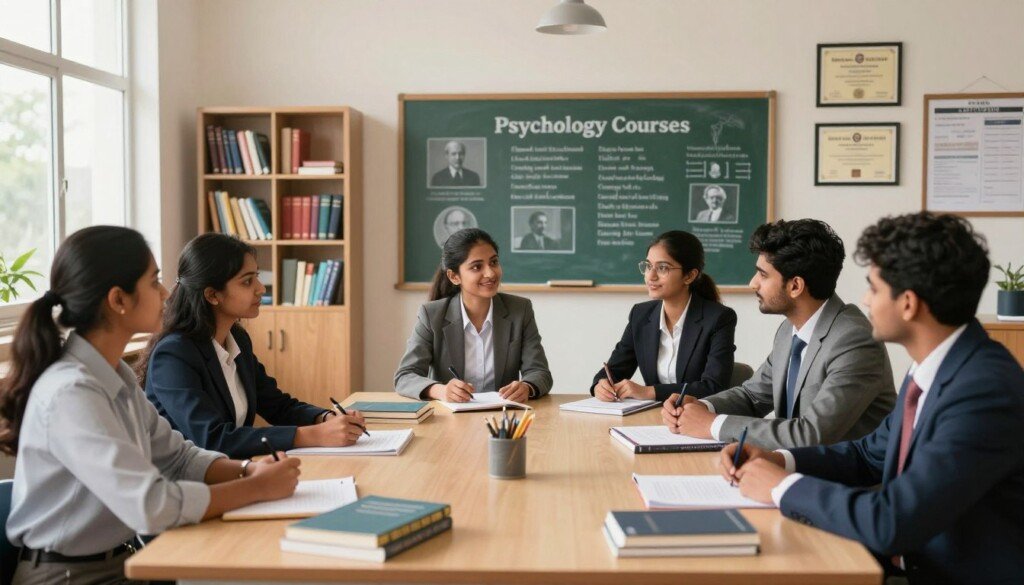
Exploring the best colleges and universities for psychology in India reveals a wide range of top institutions. These places offer excellent degree courses in psychology. They cater to the growing need for mental health professionals.
Top Central Universities: Delhi University, BHU, JNU
Central universities in India are known for their academic excellence. They offer outstanding psychology programmes. Delhi University has a Department of Psychology with undergraduate, postgraduate, and doctoral programmes. It’s known for its research focus and experienced teachers.
BHU (Banaras Hindu University) also offers a wide range of psychology courses. Its Department of Psychology is known for its research and provides a strong academic base.
Jawaharlal Nehru University (JNU) is another top choice for psychology studies. It offers programmes that cover both theory and practical aspects of psychology.
Leading State Universities and Government Colleges
State universities and government colleges in India also provide excellent psychology programmes. These institutions have well-established departments with experienced teachers and good facilities. For example, the University of Mumbai and University of Calcutta have reputable psychology departments.
Government colleges affiliated with these universities also offer quality psychology education. They are good options for students looking for professional courses in psychology.
Premier Private Institutions: TISS, Christ University, Amity
Private institutions in India have also contributed to psychology education. Tata Institute of Social Sciences (TISS) offers a variety of psychology programmes, including clinical and applied psychology.
Christ University and Amity University are also notable for their comprehensive psychology programmes. They are known for their modern facilities, experienced teachers, and strong industry connections.
Specialised Psychology Institutes and Autonomous Colleges
There are also specialised psychology institutes and autonomous colleges offering focused programmes. These places provide diploma and certificate courses that can improve a student’s skills and job prospects.
These institutes specialise in areas like clinical psychology and counselling. They offer practical skills and knowledge in specific psychology areas. This is great for students wanting to gain practical experience.
Career Options After Completing Psychology Courses in India
After finishing your psychology degree, you have many career paths to choose from. You can work in education, research, or the corporate world. Psychology offers a wide range of options, fitting different interests and skills.
Clinical Psychology and Private Practice Opportunities
Clinical psychology is a key career for psychology graduates. You can work in hospitals, clinics, or start your own practice. Clinical psychologists help people with mental health issues.
In India, there’s a high demand for clinical psychologists. You can start with a salary of ₹4-6 lakhs a year. With more experience, you could earn up to ₹15 lakhs or more.
Organisational Psychology and HR Roles in Indian Companies
Organisational psychology is another exciting field. You can work in HR, organisational development, or as a consultant. Your job will be to improve workplace culture and employee satisfaction.
Indian companies are valuing organisational psychology more. You can start with a salary of ₹5-7 lakhs a year in HR. With experience, you could earn ₹12-18 lakhs or more.
Educational Psychology and School Counsellor Positions
Educational psychology applies psychology to improve teaching and learning. You can be a school counsellor, educational consultant, or researcher. This role helps students overcome learning challenges.
School counsellors are needed in both private and government schools in India. Starting salaries range from ₹3-6 lakhs a year. Experienced counsellors can earn up to ₹10 lakhs or more.
Research and Academic Careers in Universities
If you love research, academia might be for you. You can work as a research assistant, lecturer, or professor. A postgraduate or doctoral degree is often needed for senior roles.
Academic careers let you contribute to psychology through research and teaching. Starting salaries are around ₹4-7 lakhs a year. With experience, you can earn more.
Government Jobs: UPSC, State PSC, and Hospital Positions
Psychology graduates can also find government jobs. You can take exams like UPSC or State PSC for government roles. Government hospitals and mental health institutions also hire psychologists.
Government jobs offer stability and a steady income. Salaries range from ₹4-8 lakhs a year, depending on the role and experience.
Salary Expectations for Psychology Professionals in India
In India, your salary as a psychology professional can change a lot. It depends on your area of work and how long you’ve been doing it. Psychology has many special areas, each with its own pay.
Entry-Level Salaries: What Fresh Graduates Can Expect (₹3-6 Lakhs)
New psychology graduates can earn between ₹3 to ₹6 lakhs a year. This amount can change based on the job, where you work, and if you have extra qualifications.
Jobs in schools or charities might pay differently than corporate or clinical roles. It’s key for new graduates to look into the market and know what they can expect.
Mid-Career Earnings by Specialisation (₹6-15 Lakhs)
As you gain more experience, your salary can go up. Mid-career professionals might earn between ₹6 to ₹15 lakhs a year. This depends on your specialisation.
Fields like clinical, organisational, and educational psychology have different pay levels. For example, clinical psychologists in hospitals or private practice might earn more than those in schools or companies.
Top-Paying Sectors: Corporate, Clinical, and Consulting (₹15+ Lakhs)
Some areas pay more for psychology professionals. The corporate world values organisational psychologists for their insights. Clinical psychologists, and those in mental health consulting, can also earn more.
People in these fields can make over ₹15 lakhs a year. Experienced consultants or those with special skills might earn even more.
Salary Comparison with Other Professional Courses
It’s good to compare psychology salaries with other professional courses in India.
| Professional Course | Entry-Level Salary (₹ Lakhs) | Mid-Career Salary (₹ Lakhs) |
|---|---|---|
| Psychology | 3-6 | 6-15 |
| Engineering | 4-8 | 8-20 |
| Management | 5-10 | 10-25 |
Psychology might not have the highest starting salaries. But it offers a rewarding career with chances for growth and specialisation.
Step-by-Step Guide to Securing Admission in Psychology Programmes
Getting into a psychology programme needs a smart plan. You must know the process well and be ready to stand out among others.
Research and Shortlist Colleges Based on Your Goals
Start by finding colleges that match your career dreams. Look at their curriculum, the skills of their teachers, and their reputation.
- Find colleges with specialisations that interest you.
- Make sure the college is accredited.
- Think about the location and how it affects your learning.
Prepare for Entrance Exams with Targeted Study Plans
Most colleges need you to pass entrance exams. You need a good study plan for this.
- Know what the exam covers and how it’s structured.
- Make a study plan that covers everything you need to know.
- Use sample papers and mock tests to practice.

Complete Application Forms and Meet Deadlines
After preparing for exams, fill out your application forms and send them on time.
- Have all your documents ready, like transcripts and ID.
- Fill out the form correctly and accurately.
- Send your application early to avoid any last-minute problems.
Appear for Counselling Sessions and Interviews
Many places have counselling sessions and interviews as part of their application.
Get ready by learning common interview questions and practising your answers. Show your passion for psychology and your knowledge of the field.
Understand Fee Structure and Scholarship Options
Lastly, know the costs and look for scholarships to manage your money better.
- Find out the total cost of the programme, including all fees and expenses.
- Look for scholarships you can apply for.
- Think about education loans if you need them.
By following these steps, you can increase your chances of getting into a psychology programme that fits your career goals. For more help and advice, visit GlobalCareerLabs.com.
Essential Skills You Need to Succeed in Psychology Careers
Psychology professionals need to develop key skills to help their clients. These skills are important for building strong relationships and providing effective support. They also help in conducting accurate assessments and implementing treatments based on evidence.
Communication and Interpersonal Skills for Client Interaction
Good communication is crucial in any psychology career. You must listen well, understand clients’ feelings, and explain things clearly. Strong interpersonal skills help you build trust and rapport with clients, which is key for successful therapy.
Key aspects of communication and interpersonal skills include:
- Active listening
- Clear and concise language
- Non-verbal communication awareness
- Cultural sensitivity
Analytical and Research Abilities for Evidence-Based Practice
Psychology professionals need to critically evaluate research and apply evidence-based practices. This requires strong analytical skills, like interpreting data and drawing conclusions.
Developing analytical and research abilities involves:
- Staying updated with the latest research in the field
- Critically evaluating the quality of research studies
- Applying research findings to real-world problems
Empathy and Emotional Intelligence in Professional Settings
Empathy and emotional intelligence are key for understanding clients’ experiences. These skills help you navigate complex emotional situations and offer compassionate support.
Empathy and emotional intelligence can be developed by:
- Engaging in self-reflection and self-awareness practices
- Developing an understanding of different emotional responses
- Cultivating a non-judgmental attitude
Critical Thinking and Problem-Solving Capabilities
Critical thinking and problem-solving are essential for psychology professionals. They help assess complex situations, find solutions, and implement effective interventions.
| Skill | Description | Application in Psychology |
|---|---|---|
| Critical Thinking | Analyzing information objectively | Evaluating the effectiveness of interventions |
| Problem-Solving | Identifying and addressing problems | Developing treatment plans tailored to individual needs |
Future Scope and Emerging Trends in Psychology in India
India’s psychology sector is growing fast, with new trends and specialisations popping up. These changes aim to meet the country’s varied mental health needs. If you’re thinking about a career in psychology, knowing these trends can guide your choices.
Digital Mental Health and Teletherapy Platforms
The COVID-19 pandemic has made digital mental health services more common in India. Teletherapy platforms are now widely used, making it easier for people to get mental health help. As a psychology pro, you might work on online therapy programs or help clients through teletherapy platforms.
Key areas of growth in digital mental health include:
- Development of mobile apps for mental health support
- Online counselling and therapy services
- Artificial intelligence-powered mental health tools
Sports Psychology for Indian Athletes and Teams
Sports psychology is gaining traction in India, seen as key to boosting athletic performance. As a sports psychologist, you could help Indian athletes and teams get better mentally and perform better.
Some key applications of sports psychology include:
| Application | Description |
|---|---|
| Performance Enhancement | Techniques to improve focus, confidence, and overall performance |
| Injury Rehabilitation | Supporting athletes in their recovery from injuries |
| Team Dynamics | Improving communication and cohesion within teams |
Forensic Psychology and Legal System Applications
Forensic psychology is another area with big growth potential in India. Specialists in Forensic Psychology blend psychology and law, helping with legal issues. They assess criminal behaviour, give expert court testimony, and create rehab programs for offenders.
Workplace Wellness Programmes in Indian Corporates
Workplace wellness is key in Indian companies, as they see its link to productivity and business success. As a psychology pro, you could help design and run workplace wellness programs. This creates healthier, more supportive work environments.
Some key components of workplace wellness programmes include:
- Stress management workshops
- Employee engagement initiatives
- Mental health support services
Exploring psychology careers, keep these trends in mind. They can help you find areas that match your interests and skills. Whether it’s digital mental health, sports psychology, forensic psychology, or workplace wellness, there are many ways to make a difference.
Conclusion
Now you know that studying psychology after 12th can open doors to many careers. These include roles in healthcare, education, and corporate sectors. Psychology is becoming a sought-after career in India, thanks to the need for mental health experts.
Exploring psychology courses, you’ve seen the different paths you can take. From clinical to organisational psychology, there’s something for everyone. This field offers a variety of options based on your interests and skills.
If you’re thinking about a career in psychology, getting advice is crucial. GlobalCareerLabs.com provides career counselling to guide you. They help you find the right path based on your strengths and interests.
Ready to start your career journey? Visit GlobalCareerLabs.com for career counselling. Discover the many opportunities waiting for you after completing psychology courses after 12th.
Frequently Asked Questions
Can I apply for psychology courses after 12th if I studied Science or Commerce?
What is the main difference between a B.A. and a B.Sc. in Psychology?
Do I need to sit for an entrance exam like CUET to study psychology?
How does a psychologist differ from a psychiatrist in India?
What kind of salary can a psychology graduate expect in 2026?
Are there any vocational or diploma courses available right after school?
Why should I seek professional career counselling before choosing a psychology programme?
Your future begins with making the right choice today.
Start Now!
🇮🇳 INDIAN GOVERNMENT LINKS
🌍 INTERNATIONAL LINKS
- American Psychological Association (APA) — Education & Career URL
- https://www.nirfindia.org/Rankings/2024/CollegeRanking.html
Useful Resources
- Free Psychometric Aptitude Test
- https://globalcareerlabs.com/aptitude-test/
- https://globalcareerlabs.com/what-is-psychometric-assessment/
- https://globalcareerlabs.com/psychometric-assessment-meaning/
Related posts:
 BBA Course: Your Complete Guide – College List, Subjects, Fees & Career Options
 Data Science Course After 12th: Best Options & Career Path
 Career Options After 12th in India: Know How to take The Right Decision
 Medical Courses After 12th Without NEET: 20+ Options 2026
 Industrial Training: Importance, Types & How to Find One 2026
 BBA 1st Year Subjects: Complete Syllabus & Subject List 2026
 Data Science Jobs for Freshers: How to Get Your First Job 2026
 Career Counsellor: Your Complete Guide to Finding the Right Counsellor
 Psychometric Test Meaning: Your Complete Guide for Career Assessment
 Diploma Courses After 10th: Complete List with Fees 2026
 Career Guidance: Complete Roadmap to Find Your Dream Job in 2026
 Career Aptitude Test: Choose Your Right Career Path Now in 2026
 Career Counselling After 12th: Ultimate Guide for Career Planning
 Which Career Is Best for Me: Ultimate Guide to “Best Careers”
 Career Counselling Near Me: Find The Best Career Counsellor
 Bio Courses After 12th: Best Options Beyond MBBS & NEET 2026
 Interior Design Courses After 12th: Complete Guide for 2026
 Non Medical Subjects in 11th Class: Complete List 2026
 Nursing Course After 12th: Admission, Fees & Career Scope 2026
 6 Month Courses After 12th: For Quick Career Success
Powered by YARPP.