
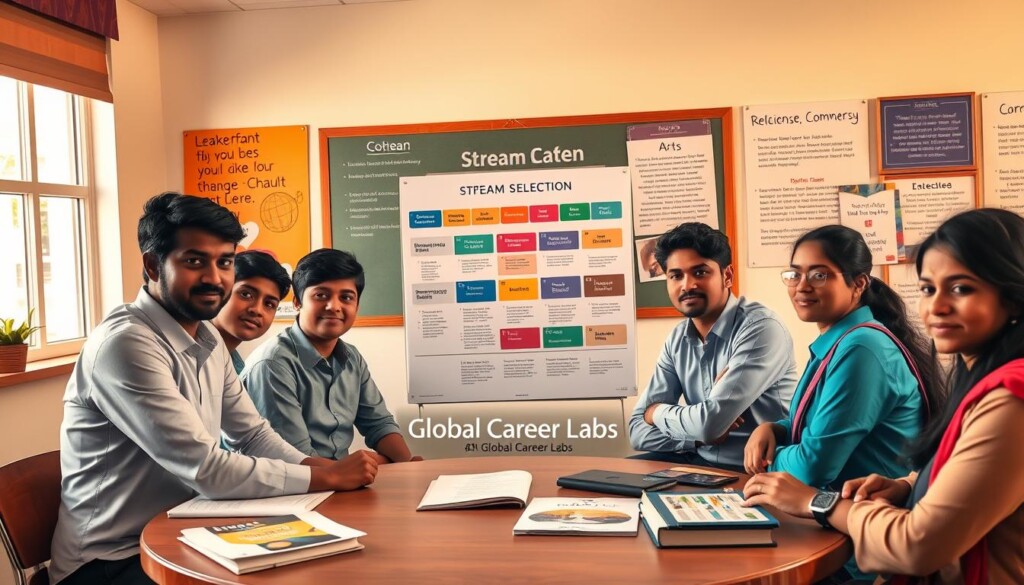
The exams may be over, but the real question quietly begins at home—what comes next? Conversations with parents, advice from relatives, and comparisons with friends can make things confusing very quickly. In the middle of all this, figuring out after 10th which stream is best becomes a serious concern. The truth is, there isn’t one “best” stream—only the one that fits you the best.
This decision shapes your academic journey and eventually your career direction. Whether you dream of studying at institutions like Indian Institute of Technology Bombay or Shri Ram College of Commerce, the stream you choose now builds that foundation. A thoughtful choice helps you stay focused, avoid unnecessary detours, and move steadily toward your goals.
Exploring options like Science, Commerce, or Humanities requires more than just looking at trends—it needs honest self-reflection. Your interests, strengths, and comfort with subjects matter far more than outside opinions. When you choose with clarity, you not only manage your academic path better but also plan your future investments, including tuition costs and career preparation, more effectively.
Key Takeaways
- Evaluate your natural interest in Science, Commerce, and Arts
- Analyze long-term career growth and job market opportunities
- Research specific admission criteria for premier Indian universities
- Understand how tuition fees in INR fit your family budget
- Match your personal skills with specific professional roles
- Seek guidance to align academic choices with future lifestyle goals
Understanding the Landscape: After 10th Which Stream is Best for Your Future?
Choosing a stream after your 10th board exams is a big decision. It’s not just about what you’re good at. It’s also about what you like, what you want to do in life, and what each stream offers.
Assessing Your Personal Interests and Academic Strengths
When picking a stream, think about what you enjoy and what you’re good at. Being passionate about certain subjects can really help you do well and feel happy in your chosen stream. For example, if you love solving math problems, Science might be for you. If you’re more into people and society, Arts could be the right fit.
Knowing your strong subjects is also key. Figuring out where you excel can help you decide. If you’re great at math and science, Science with PCM (Physics, Chemistry, Mathematics) might be best. If you’re good with numbers and like to analyze, Commerce could be the way to go.
The Role of Parents and Peer Pressure in Decision Making
But, don’t forget about your parents and friends. Many students feel pressure from their parents to pick a certain stream. It’s important to talk to your parents about what you want to do. This way, you can make sure you’re both on the same page.
Friends can also influence your choice. Talking to your friends about your plans can give you good advice. But, remember to choose what’s best for you, not just what your friends want.
By thinking about your interests, strengths, and what others think, you can make a better choice. This will help you decide which stream to follow after your 10th board exams.
Deep Dive into the Science Stream: Opportunities and Challenges
Choosing the Science stream after 10th grade can lead to a career in tech, healthcare, or research. It’s perfect for those who love solving problems and enjoy experiments. Students who excel in analytical thinking and logic will find it rewarding.
Core Subjects and Specializations: PCM vs. PCB
The Science stream has different subject combinations. Physics, Chemistry, and Mathematics (PCM) and Physics, Chemistry, and Biology (PCB) are the most common. PCM is great for engineering, while PCB is best for medical and biological sciences.
If you dream of engineering, PCM with Mathematics is a good choice. For those interested in medicine or biological sciences, PCB is the better option.
Top Indian Entrance Exams: JEE Main, JEE Advanced, and NEET
To get into top Indian colleges, you must pass key entrance exams. JEE Main and JEE Advanced are key for engineering. NEET is the exam for medical colleges.
- JEE Main: The first step towards engineering colleges like NITs and IIITs.
- JEE Advanced: For admission to IITs and other prestigious engineering institutions.
- NEET: The sole entrance exam for MBBS and BDS courses in India.
Career Paths in Engineering, Medicine, and Pure Sciences
The Science stream offers many career paths. With PCM, you can study engineering in fields like mechanical, electrical, or computer science. PCB leads to careers in medicine, biotechnology, or research.
| Stream | Specialization | Career Paths |
|---|---|---|
| PCM | Engineering | Mechanical Engineer, Software Developer, Aerospace Engineer |
| PCB | Medical Sciences | Doctor, Research Scientist, Biotechnologist |
Fee Structures in Top Institutions like IITs, NITs, and AIIMS
Top Indian colleges have different fees. IITs charge between ₹2 lakhs to ₹3 lakhs per year for undergrad studies. NITs cost between ₹1.5 lakhs to ₹2.5 lakhs. AIIMS, New Delhi, charges around ₹1.5 lakhs per year for MBBS.
Knowing these costs helps plan your education. Look into scholarships and loans to help with expenses.
Exploring the Commerce Stream: Finance, Business, and Beyond
The Commerce stream opens doors to many opportunities in finance and business. It’s perfect for those interested in business and managing money. You’ll learn about business and economics, preparing you for a career in business or starting your own company.
Key Subjects
The Commerce stream focuses on key subjects. These subjects help you understand business and economics well. You’ll study:
- Accountancy: Learning about financial records, budgeting, and reports.
- Business Studies: Exploring how businesses work, entrepreneurship, and how organizations behave.
- Economics: Studying economic systems, market structures, and international trade.
Professional Courses
After your 12th grade in Commerce, you can take professional courses. These courses can boost your career. Some popular options include:
- CA (Chartered Accountancy): Becoming a certified accountant.
- CS (Company Secretary): Learning about corporate laws, governance, and secretarial practices.
- CMA (Cost and Management Accountancy): Focusing on cost management, financial planning, and strategic management.

Top Colleges for Commerce in India
India has many top colleges for Commerce programs. Some of the best include:
- SRCC (Shri Ram College of Commerce): Known for its tough academic environment and great job placements.
- NMIMS (Narsee Monjee Institute of Management Studies): Offers a wide range of Commerce specializations.
- Christ University: Provides a detailed Commerce program with a focus on practical learning.
Salary Expectations and Job Roles
Commerce graduates have many job opportunities. Some common roles are:
- Financial Analyst: Analyzing financial data to help make business decisions.
- Marketing Manager: Creating marketing strategies to promote products or services.
- Business Development Manager: Finding new business opportunities and building partnerships.
Salaries for Commerce graduates vary based on job, industry, and location. But, with the right skills and experience, you can earn ₹4-10 lakhs a year at the start.
The Versatility of the Arts and Humanities Stream
The Arts and Humanities stream is full of opportunities for students who love creativity and culture. It’s not just about a few jobs. It offers many subjects and careers for different interests and dreams.
Breaking Myths: Why Arts is a Gateway to Diverse Careers
Many think the Arts stream is less profitable and has fewer jobs than Science or Commerce. But this is not true. It includes subjects like History, Geography, Psychology, and Languages. These can lead to careers in media, law, social work, and education.
Career diversity is a big plus of the Arts stream. Students can explore many fields such as:
- Journalism and Mass Communication
- Social Work and Non-Profit Management
- Law and Legal Studies
- Teaching and Education
- Creative Writing and Publishing
Emerging Fields: Psychology, Mass Communication, and Design
Recently, Psychology, Mass Communication, and Design have become more popular in the Arts stream. These areas offer exciting career paths and chances to use knowledge and skills in new ways.
Psychology is growing fast, with jobs in clinical psychology, counseling, and research. Mass Communication includes journalism, advertising, and digital media, with many career options.
Entrance Exams and Admissions: CUET and University-Specific Tests
To get into top Arts colleges in India, you need to pass entrance exams like CUET or university tests. Preparing for these exams is tough but essential for a good college seat.
Top Arts and Humanities colleges in India include Delhi University, Jawaharlal Nehru University (JNU), and Tata Institute of Social Sciences (TISS). They offer many undergraduate and postgraduate programs for different interests and goals.
Top Institutions: Delhi University, JNU, and TISS
Delhi University, JNU, and TISS are top names in Arts and Humanities in India. They have a wide range of programs and are known for their academic excellence.
| Institution | Notable Programs | Entrance Exam |
|---|---|---|
| Delhi University | BA (Hons) in History, English, Psychology | CUET |
| JNU | BA (Hons) in Social Sciences, Humanities | CUET/JNU Entrance |
| TISS | BA in Social Sciences, MSW | TISS Entrance |
Navigating Vocational and Diploma Courses After 10th
After finishing your 10th standard, think about vocational and diploma courses. They mix theory and practical skills. This prepares you for work or more education.
Polytechnic Diplomas: Engineering and Technical Skills
Polytechnic diplomas are a top pick for many students. They focus on engineering and technical fields. These 3-year programs give you real-world experience in fields like mechanical and electrical engineering.
Diploma holders are often in demand in industries such as manufacturing, construction, and IT.
You can study diplomas in many areas, like:
- Mechanical Engineering
- Electrical Engineering
- Civil Engineering
- Computer Science and Engineering
Teacher Training Programs: Understanding DELED
Teacher training programs, like the Diploma in Elementary Education (DELED), are great for those who love teaching. DELED is a 2-year diploma that teaches you how to teach at the elementary level. This course is perfect for those who want to shape young minds and make a difference in education.
Short-term Certification Courses for Immediate Employability
Short-term certification courses are also a good choice. They offer specialized skills that employers want. These courses last from a few months to a year and cover topics like digital marketing and data analysis.
Certification in these areas can boost your job chances and open doors in competitive fields.
Comparing Streams: Science vs. Commerce vs. Arts
Choosing Science, Commerce, or Arts after 10th grade is a big decision. It’s a step towards your future. Each stream has its own strengths and needs. Knowing these differences is key to making a good choice.
Flexibility and Switching Streams in Higher Education
When picking a stream, think about its flexibility and switching options in college. Science and Commerce are often more set because of their specific subjects. But Arts offers a wider range of subjects and choices, giving you more freedom.
Key points to consider:
- Science students might move to Commerce or Arts if they’re good at math or languages.
- Commerce students might easily switch to Arts because of similar subjects like economics.
- Arts students might find it hard to switch to Science or Commerce without the right background.

Analyzing Long-term Career Growth and Market Demand in India
When choosing a stream, think about your future career and market demand. Here’s a quick look:
Career prospects and growth:
- Science offers great jobs in engineering, medicine, and research, with lots of room to grow.
- Commerce leads to careers in finance, accounting, and management, with steady demand.
- Arts opens up to various careers in media, design, psychology, and more, with growing demand in creative fields.
How to Align Your Choice with Future Industry Trends
To match your stream with future trends, do the following:
- Look into new fields and growth areas in the Indian job market.
- Work on skills that match your stream, like digital marketing, data analysis, or coding.
- Keep up with industry reports and forecasts to guide your choices.
By knowing what each stream offers and aligning with your interests and future trends, you can make a choice. This choice will not only meet your current academic goals but also lead to a successful and rewarding career.
Financial Planning for Higher Education in India
Planning your finances is crucial when choosing a stream for higher education in India. As you look at options after your 10th grade, knowing the financial impact of your choices is important. This helps you make a well-informed decision.
Fee Variations Across Institutions
The cost of higher education in India varies a lot. Government colleges are often cheaper, with fees from ₹50,000 to ₹2 lakhs a year for undergraduate courses. Private colleges, on the other hand, can cost between ₹2 lakhs and ₹10 lakhs or more annually.
Here’s a comparison of average annual fees for different streams in government and private colleges:
| Stream | Government Colleges (₹) | Private Colleges (₹) |
|---|---|---|
| Science | 50,000 – 1 lakh | 2 lakhs – 5 lakhs |
| Commerce | 30,000 – 80,000 | 1 lakh – 3 lakhs |
| Arts | 20,000 – 50,000 | 50,000 – 2 lakhs |
Scholarship and Education Loan Options
There are many scholarships and education loans to help with costs. Government schemes like the Central Sector Scheme of Scholarship for College Students and Post-Matric Scholarship for SC/ST/OBC students offer financial help. Private organizations and NGOs also give scholarships to deserving students.
Education loans are another good option. Banks like State Bank of India and HDFC Bank offer loans with good interest rates and flexible repayment plans.
Return on Investment
When picking a stream, think about the return on investment (ROI). Course costs are important, but starting salary and career prospects are key too. For example, engineering graduates from top schools like IITs can earn over ₹8 lakhs a year. Arts graduates might start with lower salaries, but can still grow in their careers over time.
It’s important to balance course costs with expected salaries and career growth. This helps make a financially wise choice.
Preparing for the Transition: From Board Exams to Stream Selection
Passing your board exams is just the start. Now, you get to pick a stream that fits your career dreams. This choice is key because it shapes your future in school and work.
How to Research Colleges and Course Curriculums
First, focus on the stream you want. Then, look into colleges and their courses. Find out what subjects are needed for your stream. Also, learn about entrance exams and how to get into different colleges.
Key steps to research colleges:
- Look for colleges that offer your preferred course
- Check the curriculum and syllabus
- Understand the admission criteria and entrance exams required
- Read reviews and feedback from current and former students
Building a Skill Set Beyond the Classroom
Just having good grades isn’t enough today. You must also develop skills that make you unique. These can be related to your stream or general skills everyone values.
Consider the following skills:
- Communication and presentation skills
- Problem-solving and critical thinking
- Leadership and teamwork
- Digital literacy and basic coding skills
Seeking Career Counseling and Mentorship
Career counseling can help you understand your strengths and interests. It guides you in choosing the right stream. Mentors from your desired field offer practical advice and support.
Benefits of career counseling:
- Personalized guidance based on your interests and strengths
- Insights into various career paths and their requirements
- Assistance in setting realistic goals and creating an action plan
Conclusion
Choosing the right stream after 10th is a big decision that shapes your future. We’ve looked at Science, Commerce, and Arts streams and their opportunities. It’s important to know your interests and strengths to make a good choice.
Deciding which stream is best for you after 10th depends on knowing yourself well. You should research the career paths in each stream. Your choice should match your long-term goals and dreams.
When making your decision, think about fees, entrance exams, and job roles. This helps you find a career that fits your skills and interests. The right stream is one that aligns with your personal and professional goals.
FAQ
How do I determine the right 10th pass stream selection for my personality?
What is considered the best stream for future India in the next decade?
When should I begin researching my stream after board exam results are released?
How do I choose between science vs commerce vs arts if I have high grades in all subjects?
Are there affordable options for high-quality education in the Science stream?
Can I pursue a professional career like Chartered Accountancy if I choose the Arts stream?
What are the benefits of choosing a Polytechnic Diploma over a traditional 11th and 12th-grade path?
How much weight should I give to my parents’ advice during this decision?
Your future begins with making the right choice today. Start Now!
GlobalCareerLabs.com
Your Partner in Career Success
- Indian Institute of Technology Mumbai
👉 https://www.iitb.ac.in
(Explore engineering pathways, eligibility, and academic structure for Science stream aspirants) - Institute of Chartered Accountants of India
👉 https://www.icai.org
(Official body for CA pathway—ideal for Commerce stream students) - National Law School of India University
👉 https://www.nls.ac.in
(Top law school—great reference for Humanities/Arts career pathways) - All India Council for Technical Education
👉 https://www.aicte-india.org
(Regulatory body for technical education and career planning insights)
Disclaimer:
The salary figures, course details, and career information provided in this article are for general reference only and may vary based on location, company, experience, and market conditions. Readers are advised to independently verify all information in the blog, from official and authentic sources. GlobalCareerLabs.com does not guarantee the accuracy or authenticity of this data. And so, Global Career Labs shall not be held responsible for any decisions made based on this information
Related posts:
 Best Stream After 10th: Plan your next move now
 Career Guidance After 10th: Your Complete Success Roadmap
 Diploma Courses After 10th: Ultimate Options for Students 2026
 Careers for Analytical Thinkers: Proven Roadmap to Success 2026
 Cyber Security Jobs: Best Career Options for 2026
 Cybersecurity Jobs for Freshers: How to Get Hired 2026
 Digital Marketing Course 2026: How to Start a High-Paying Career
 Career Aptitude Test: Choose Your Right Career Path Now in 2026
 Central Government Jobs: Your Ultimate Career Guide for 2026
 Aptitude Test for Students: Find Your Right Career Path Now
 Career Counsellor: Your Complete Guide to Finding the Right Counsellor
 Psychometric Test for Career: Unlock Your Right Career Path
 Personality Development: Your Key To Ultimate Career Success
 How to Become A Data Scientist in 2026 Without Coding Knowledge: Earn More than ₹10 LPA Salary
 Data Science Career 2026: Complete guide to high paying jobs in AI Era
 Career Confusion in Children: Causes, Effects And “How to Get Clarity”
 Biotechnology Careers – Your Ultimate Guide to ₹10-30 Lakh Salaries
 Humanities Stream Subjects in Class 11 & 12: Complete Subject List, Scope & Career Options
 ANM Nursing Courses After 10th: Admission, College List & Careers 2026
 Psychology Courses After 10th: Get Started Early in 2026
Powered by YARPP.