
Do you remember those late nights studying for JEE or UPSC? You felt the pressure of your family’s hopes. Now, you’re ready to change your career path.
You want to use your graduation degree to lead. This is your chance to move up in the Indian job market.
Getting a top mba course is key. It’s not just about getting a degree. It’s about earning a salary that shows your hard work and skills.
Understanding the cost is crucial. Mba fees in India vary a lot. They range from 15 to 25 lakh at top IIMs to just 1 lakh at some government schools. This guide will help you make a choice that fits your budget and promises a great return.
Key Takeaways
- Premier institutes like IIMs typically charge between 15 and 25 lakh for a two-year programme.
- Government universities and tier-2 colleges offer affordable options ranging from 1 to 5 lakh.
- Top Indian companies look for graduates for high-paying jobs.
- Getting into a top MBA program usually means doing well in exams like CAT, MAT, or state tests.
- A full-time MBA in India usually lasts two years.
- Graduates often see their salaries increase a lot, often in lakhs.
Understanding MBA Education: What It Means for Your Career
In the competitive world of business, an MBA can unlock new career paths and personal growth. An MBA, or Master of Business Administration, gives you the skills and knowledge to succeed in many industries. It also offers great networking opportunities.
For Indian students, an MBA is a strategic choice to boost their career. The Indian business world is vast, with many sectors like finance, marketing, and operations. These sectors value MBA graduates for their business acumen and leadership skills.
An MBA opens up a wide range of career options. Whether you’re into consulting, finance, entrepreneurship, or corporate leadership, an MBA provides a solid base. Top Indian companies and global corporations often look for MBA graduates for key roles.
| Industry | Average Salary Range (INR Lakhs per annum) | Key Roles |
|---|---|---|
| Finance | 8-15 | Investment Banking, Financial Analyst |
| Marketing | 7-12 | Brand Manager, Marketing Manager |
| Consulting | 9-16 | Management Consultant, Strategy Consultant |
| Human Resources | 6-10 | HR Manager, Talent Acquisition Manager |
When thinking about your career, understanding the value of an MBA is key. It’s not just a degree; it’s about the skills, network, and opportunities it brings. By getting an MBA, you’re investing in your future and opening doors to new and exciting career paths.
Types of MBA Courses Available for Indian Students
The Indian MBA scene has many options for students. You can pick from full-time, executive, and online programs. Each type suits different career goals and personal situations.
Full-Time Two-Year MBA Programmes
Full-time MBA programs are the classic choice. They give a deep management education over two years. They’re perfect for those wanting to move into management or change careers. Top institutions like IIMs and XLRI have well-regarded full-time MBA programs.
Executive MBA for Working Professionals
Executive MBA (EMBA) programs are for those already working. They help enhance managerial skills without quitting the job. These programs are shorter and flexible, fitting into busy schedules. Many top B-schools in India offer EMBA programs for senior professionals.
Distance and Online MBA Options
Distance and online MBA programs are great for those with work or family commitments. They’re perfect for working people or those far from campus. Several Indian universities provide online and distance MBA programs that employers respect.
Integrated MBA Programmes After Class 12th
Integrated MBA programs blend undergrad and MBA studies into one, lasting five years. They’re great for students who know their career path early. Institutions like IITs and NITs offer these programs for a smooth transition from undergrad to postgraduate studies.
Specialised MBA Courses: Finance, Marketing, HR, and More
Specialised MBA courses focus on specific areas like finance, marketing, or HR. They give deep knowledge and skills in your chosen field. Many B-schools have these programs, tailored to industry needs.
Essential MBA Entrance Exams You Need to Know
MBA hopefuls in India face many entrance exams to get into their dream business school. The competition is fierce, with several exams crucial for admission to top schools.
CAT: The Gateway to IIMs
The Common Admission Test (CAT) is a top MBA exam in India, mainly for IIMs. CAT scores are highly valued, marking a big step towards top B-schools.
As an education expert says, “CAT is not just an exam; it’s a gateway to the best management education in India.”
“The CAT exam is a highly competitive exam that tests a candidate’s aptitude in various areas, including quantitative ability, verbal ability, and data interpretation.”
XAT: For XLRI and Associate Institutions
The Xavier Aptitude Test (XAT) is a key MBA exam, mainly for XLRI, Jamshedpur, and its associates. XAT is known for its unique pattern and difficulty, making it a challenging yet rewarding exam.
XAT scores are accepted by over 150 business schools across India, offering many opportunities for MBA aspirants.
CMAT, MAT, SNAP, and State-Level Exams
Other national-level MBA entrance exams include CMAT, MAT, and SNAP. CMAT is conducted by the National Testing Agency (NTA) and is accepted by various central and state universities.
- CMAT: Accepted by many universities and colleges across India.
- MAT: Conducted by the All India Management Association (AIMA) and accepted by numerous B-schools.
- SNAP: Used by the Symbiosis International University for its various MBA programs.
Also, several state-level exams are conducted for MBA admissions in state universities and colleges.
GMAT: For International and Premium Indian B-Schools
The Graduate Management Admission Test (GMAT) is a globally recognized MBA entrance exam, accepted by many international business schools and some premium Indian B-schools. GMAT scores are considered a benchmark for MBA admissions worldwide.
Many top business schools abroad require GMAT scores as part of their admission process. In India, some prestigious institutions like the Indian School of Business (ISB) also accept GMAT scores.
Eligibility Requirements for MBA Admission in India
Starting your MBA journey in India? Knowing the eligibility criteria is key. Each school has its own rules, but there are common ones most follow.
Minimum Educational Qualifications
To get into an MBA in India, you need a bachelor’s degree from a known university. The marks needed can differ by school.
Key Points to Note:
- A bachelor’s degree in any field is okay.
- The degree must be from a recognised university.
- Some schools might ask for a certain mark in your degree.
Graduation Percentage Criteria
MBA colleges in India often look for a minimum graduation score. This score is usually between 45% and 50%. But, the best schools might ask for more.
For instance:
- IIMs want at least 50% in your graduation.
- Some top private schools might ask for a higher score.
- SC/ST/OBC candidates might get a 5% to 10% mark relaxation.
Work Experience: When It’s Required and When It’s Not
Work experience isn’t always needed for MBA admission. But, it’s important for many schools, and more so for Executive MBA programs.
Work Experience Requirements:
- Full-time MBA programs usually don’t need work experience, but it helps.
- Executive MBA programs need 2 to 5 years of work experience.
- Some top B-schools might prefer candidates with work experience for regular MBA programs.
Age Limits and Reservation Policies for SC/ST/OBC Candidates
Age limits for MBA programs are not strict. But, some schools have specific rules. Also, SC/ST/OBC candidates get special treatment as per government rules.
Reservation Policies:
- SC/ST/OBC candidates get mark relaxations for eligibility.
- Some schools follow government rules for reservations.
- Always check the reservation policies of the schools you’re applying to.
MBA Programme Duration and Course Structure Explained
Knowing about MBA programme duration and structure is key to choosing the right business education. In India, MBA programmes vary in length and content. This depends on the programme type and the school offering it.
Standard Two-Year Full-Time MBA Timeline
The two-year full-time MBA programme is common in India. Schools like the Indian Institutes of Management (IIMs) offer it. It covers all business management areas, such as finance and marketing.
This programme has four semesters. The first year focuses on core subjects. The second year lets you specialise with elective courses. Many schools also include internships and summer placements for practical experience.
One-Year Accelerated MBA Programmes
Some schools in India have one-year accelerated MBA programmes. These are for those with work experience or a postgraduate degree. They pack a lot into a short time.
One-year programmes are great for working professionals. They help you quickly improve your management skills. Schools like the Indian School of Business (ISB) offer these.
Semester-Wise Curriculum Breakdown
MBA programmes are split into semesters. This structure helps you learn and specialise gradually. It includes both core and elective courses.
| Semester | Typical Courses |
|---|---|
| 1st Semester | Financial Accounting, Managerial Economics, Business Environment |
| 2nd Semester | Marketing Management, Financial Management, Operations Management |
| 3rd Semester | Electives (e.g., HRM, International Business, Business Analytics) |
| 4th Semester | Specialisation Courses, Project Work, Internship/Dissertation |
Internships, Summer Placements, and Final Placements
Internships, summer placements, and final placements are key in MBA programmes. They give you real-world experience. You also get to build professional networks.
Top business schools have placement cells. They help with campus placements to leading companies. The process starts with summer internships and ends with final placements.
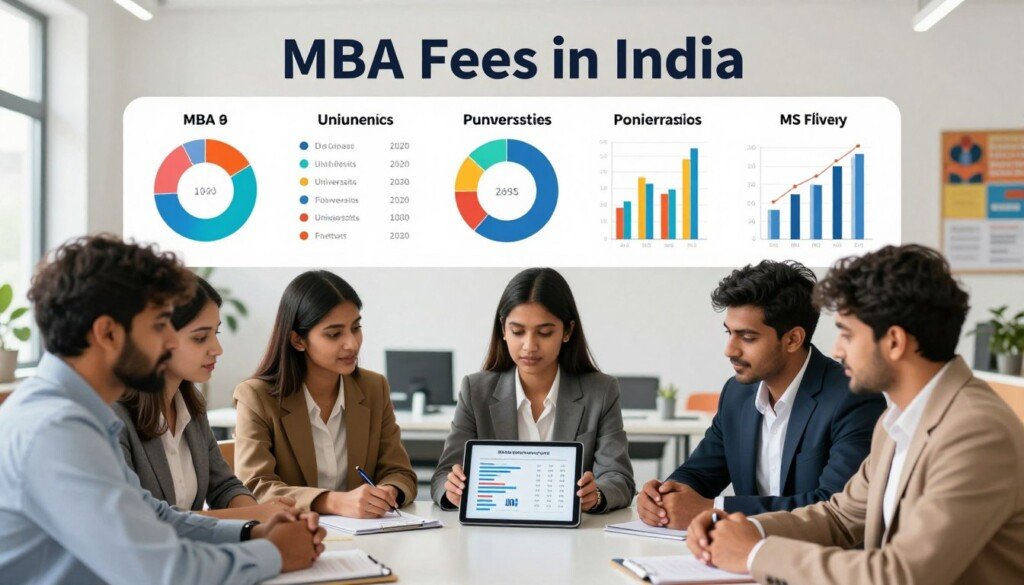
Complete MBA Fees Breakdown: What You’ll Actually Pay
It’s important to know the costs of MBA courses in India. The fees can change a lot, depending on the school’s type and reputation.
The average cost for an MBA in India is between ₹8–₹25 lakh for top private schools. Government universities charge between ₹1–₹5 lakh. This shows the need to look closely at different schools’ fees.
IIM Fee Structure: From IIM Ahmedabad to Newer IIMs
The Indian Institutes of Management (IIMs) are very prestigious in India. Their fees are often higher than other schools.
The two-year MBA at IIM Ahmedabad costs around ₹20 lakh, including hostel fees. Newer IIMs might charge slightly different amounts, but it’s usually similar.
| IIM Institution | Total Fees (₹ in lakh) |
|---|---|
| IIM Ahmedabad | 20 |
| IIM Bangalore | 21 |
| IIM Calcutta | 19.5 |
Government and Public Institution MBA Fees
Government and public schools offer MBA programmes at lower costs. Fees are between ₹1–₹5 lakh for the whole course.
For example, Delhi University’s Faculty of Management Studies (FMS) charges around ₹2 lakh for two years.
Private Business School Fee Range
Private business schools in India have good facilities and connections, but are more expensive. Fees can be ₹10–₹25 lakh or more for two years.
Schools like the Indian School of Business (ISB) and XLRI – Xavier School of Management charge over ₹20 lakh for their programmes.
Scholarships, Education Loans, and Financial Support Options
Many schools offer scholarships and banks provide education loans. Scholarships can be based on merit or need. Loans help with tuition and living costs.
For example, some IIMs give scholarships to students from lower-income backgrounds. Private banks offer loans with good interest rates.
Knowing about fees and financial help can help you decide on an MBA in India.
Top MBA Colleges in India: Rankings and What They Offer
India’s MBA scene is filled with top schools for different career paths. Knowing what each college offers can help you choose wisely.
Indian Institutes of Management: The Premier Choice
The Indian Institutes of Management (IIMs) are India’s top business schools. They are known for their excellent education and strong ties with the industry. With 20 IIMs across the country, they offer sought-after MBA programs.
Key Features of IIMs:
- World-class faculty with industry experience
- Strong alumni networks
- Industry-relevant curriculum
- Excellent placement records
As Rajeshwar Rao, Director of IIM Ahmedabad, once said, “The IIMs are not just institutions, they are catalysts for transforming the business landscape of India.”
“The IIMs have consistently produced leaders who have made a significant impact in the corporate world.”
IIT Business Schools: Combining Tech and Management
The Indian Institutes of Technology (IITs) are famous for engineering but also offer top management courses. IIT business schools blend technical and management education, offering a unique learning experience.
Notable IIT Business Schools:
- IIT Bombay – Shailesh J. Mehta School of Management
- IIT Delhi – Department of Management Studies
- IIT Kharagpur – Vinod Gupta School of Management
| IIT Business School | Programme Offered | Duration |
|---|---|---|
| IIT Bombay | MBA (Specialisations in Finance, Marketing, etc.) | 2 years |
| IIT Delhi | MBA, Executive MBA | 2 years, 1 year |
| IIT Kharagpur | MBA, MBA (Agri Business) | 2 years |
Leading Private Business Schools: FMS, XLRI, ISB, and Others
Private business schools like Faculty of Management Studies (FMS), XLRI, and Indian School of Business (ISB) are also highly regarded. They are known for their rigorous education and strong industry connections.
Highlights of these institutions include:
- Innovative curriculum and teaching methodologies
- Strong industry partnerships
- Excellent placement opportunities
NIT Management Departments and Government Colleges
National Institutes of Technology (NITs) also offer MBA programs. While not as well-known as IIMs or IITs, they provide quality education at a lower cost.
Some notable NITs for MBA:
- NIT Warangal
- NIT Trichy
- NIT Surathkal
State Universities and Deemed Universities Worth Considering
State universities and deemed universities also offer MBA programs. These institutions have their own strengths, like specialized courses or lower fees.
Examples include:
- Delhi University – Faculty of Management Studies
- Anna University – Department of Management Studies
When picking an MBA college, look at accreditation, faculty, alumni network, and placement stats. This will help you make a smart choice.
Your Complete MBA Admission Journey: Step-by-Step Process
Thinking about an MBA in India? It’s key to know the admission process. This journey has many steps, from setting your career goals to finishing the admission steps.
Step 1: Identify Your Career Goals and Choose Specialisations
First, define your career goals. This will guide you in picking the right specialisation. Think about the industry you want to join and the skills you need.
Step 2: Register for Relevant Entrance Exams
Most MBA colleges need entrance exam scores. The next step is to register for these exams.
CAT Registration Process and Timeline
The Common Admission Test (CAT) is crucial for top IIMs and other business schools. It opens in August and is in November. Make sure to register on time and prepare well.
Other Exam Registrations
Other exams like XAT, CMAT, MAT, and GMAT are also accepted. Know the registration times and exam patterns for these tests.
Step 3: Prepare Strategically for Entrance Exams
Good preparation is essential for MBA entrance exams. Focus on improving your Quantitative Ability, Verbal Ability, and Logical Reasoning skills.
Quantitative Ability, Verbal Ability, and Logical Reasoning
Make a study plan for all exam sections. Practice with sample papers and mock tests to track your progress.
Step 4: Appear for Exams and Check Your Scores
After preparing, take the entrance exams. Check your scores after the results are out. See how they match your desired colleges’ cut-offs.
Step 5: Submit Applications to Shortlisted Colleges
Based on your scores, choose colleges that fit you. The application process involves submitting documents and filling out the form.
Understanding CAP Rounds and Individual College Applications
Some states have a Common Admission Process (CAP) for MBA admissions. Others need individual college applications. Know the process for your chosen colleges.
Step 6: Prepare for Group Discussions and Personal Interviews
Many colleges include Group Discussions (GD) and Personal Interviews (PI) in their selection. Practice GDs and PIs, and stay updated on current events.
Step 7: Accept Your Offer and Complete Admission Formalities
After getting offers, pick the best college for your goals and budget. Finish the admission formalities, including document verification and fee payment.

MBA Career Prospects and Salary Packages in India
Thinking about an MBA? It’s key to know about career chances and salaries in India. An MBA from a well-known Indian school can boost your career. It opens doors to many jobs across different fields.
Average MBA Starting Salaries: IIMs vs Other Institutions
MBA freshers’ salaries in India vary a lot. It depends on the school, specialisation, and industry. IIM graduates often get salaries between ₹25 lakhs to ₹30 lakhs a year.
Other good business schools might offer between ₹7 LPA to ₹15 LPA. For example, IIM Ahmedabad graduates earn an average of ₹28.5 LPA. XLRI Jamshedpur and FMS Delhi offer average salaries of ₹22 LPA and ₹20 LPA, respectively.
Industry-Wise Salary Breakdown: Consulting, Finance, IT, and FMCG
MBA graduates in India get different salaries based on their chosen industry. Here’s a look:
- Consulting: ₹12 LPA – ₹25 LPA
- Finance: ₹8 LPA – ₹20 LPA
- IT and ITES: ₹7 LPA – ₹15 LPA
- FMCG: ₹6 LPA – ₹12 LPA
These figures are just examples. Salaries can change based on the company, location, and the graduate’s skills and experience.
Top Recruiting Companies: TCS, Infosys, Deloitte, McKinsey, and More
Top companies that hire MBA graduates in India include:
- TCS
- Infosys
- Deloitte
- McKinsey
- BCG
- Bain & Company
These companies offer various roles. You can work in management consulting, financial analysis, or marketing management.
Long-Term Career Growth: From Manager to CXO
An MBA can lead to senior roles. With time, MBA graduates can move up to CEO or CFO positions in their field.
“The MBA programme not only equips you with the necessary knowledge and skills but also provides a platform to network with peers and industry leaders, paving the way for future growth.”
MBA vs Engineering vs UPSC: Career Comparison for Indian Students
Indian students often compare MBA with engineering or UPSC exams. Here’s a quick look:
| Career Path | Average Starting Salary | Career Growth |
|---|---|---|
| MBA | ₹7 LPA – ₹25 LPA | Managerial and Leadership Roles |
| Engineering | ₹4 LPA – ₹8 LPA | Technical and Specialised Roles |
| UPSC | ₹₹5 LPA – ₹7 LPA (initially) | Civil Services and Administrative Roles |
The right choice depends on your career goals and interests.
Conclusion
Exploring MBA courses is key to understanding your career options. India’s MBA education scene is rich and varied. You now know about the different types of MBA programmes, entrance exams, and what you need to get in.
The job market in 2026 will value skills over degrees. This change makes choosing the right MBA course even more crucial. Whether you want to switch industries or climb the corporate ladder, there are many MBA career paths to explore.
Getting advice from experts is vital when deciding on your MBA path. GlobalCareerLabs.com provides tailored career counselling. They help match your MBA dreams with your career goals. Check out their services to start your journey towards a fulfilling career.
FAQ
What is the typical range for MBA fees in India for the 2026 academic session?
Which sources should I trust for the most accurate mba colleges ranking?
How does the mba admission process work for top-tier business schools?
What kind of mba salary package can I expect after graduating from a premier Indian institute?
What are the most lucrative mba career options available in the current Indian market?
Can I pursue an MBA if I have less than two years of work experience?
Which entrance exam is best if I want to apply to a wide range of private and government colleges?
Related posts:
 MBA Specializations List: Which One is Best for You? 2026
 Creative Careers After 12th (Non-Engineering) in India: Your Complete Guide 2025
 BBA Subjects List: Year-wise Syllabus & Core Subjects in BBA 2026
 Top 50 MBA Colleges in India 2026: Rankings, Fees & Placement
 Best Courses After 12th Commerce: Complete Guide 2026
 BBA Course Details: Fees, Duration, Subjects & Career Scope 2026
 What is BBA? Full Form, Eligibility, Syllabus & Career Options
 MBA Course Fees in India 2026: IIMs, Private & Government Colleges
 Paramedical Courses After 12th: Complete List with Fees 2026
 Career Opportunities After 12th: Complete Guide for Students 2026
 BSc Data Science: Course Details, Fees, Colleges & Career 2026
 Best Courses After 12th Commerce: Top 25 Options 2026
 MBA Fees in India 2026: Complete Fee Structure Guide
 MBA Courses List: All Specializations with Career Scope 2026
 BBA Course Duration: How Many Years is BBA in India?
 Bachelor of Business Administration (BBA): Complete Guide 2026
 MBA Course Duration: Full-Time, Part-Time & Executive MBA 2026
 BBA Course Fees in India 2026: College-wise Fee Structure
 Courses After 12th Biology: Best Career Options Without NEET 2026
 Biotechnology Courses After 12th: Career Scope & Top Colleges 2026
Powered by YARPP.