
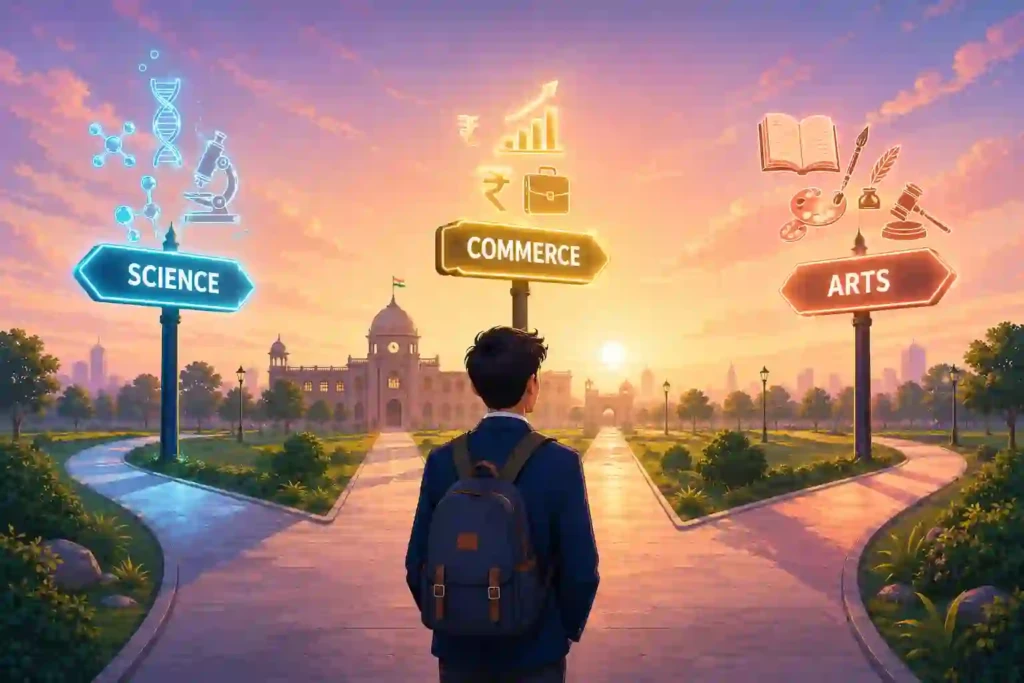
Choosing the right stream after Class 10 is the first major academic decision of a student’s life — and the question of which stream is best after 10th doesn’t have a one-size-fits-all answer. The choice you make in 2026 between Science, Commerce, and Arts will shape your Class 11 and 12 syllabus, your competitive exam options, your undergraduate degree, and the first decade of your career. Yet most students make this decision in just a few weeks, often based on parental pressure, peer choices, or a vague sense of “scope.” This complete guide will help you cut through the noise and decide which stream is best after 10th for you, specifically.
Why the Stream Decision After 10th Matters More Than You Think
India’s education system, unlike many Western models, requires early specialization. By the time you finish Class 12, your stream has already filtered which entrance exams you can write, which degrees you can pursue, and which career paths remain open.
Consider the long arc: a student who picks Science with PCM (Physics, Chemistry, Mathematics) in Class 11 keeps doors open to engineering, architecture, defence, computer applications, and even commerce-side careers. A student who picks Arts can still pursue law, civil services, journalism, design, and psychology — but engineering and medical paths are effectively closed. This isn’t a value judgment on streams; it’s a practical reality of how Indian higher education is structured.
According to the National Education Policy 2020, the rigid stream-based system is being gradually replaced with multidisciplinary flexibility. CBSE and state boards are slowly introducing skill-based subjects and inter-stream electives. However, for the 2026–27 academic year, the traditional three-stream system — Science, Commerce, and Arts (Humanities) — remains the dominant framework in most Indian schools.
The Three Streams After 10th: A Quick Overview
Before we dive deep, here’s a high-level snapshot of what each stream actually involves in 2026:
| Parameter | Science | Commerce | Arts / Humanities |
| Core Subjects | Physics, Chemistry, Maths / Biology | Accountancy, Business Studies, Economics | History, Pol. Science, Psychology, Sociology |
| Difficulty Level | High — concept-heavy, formula-driven | Moderate — application + numerical | Moderate — analytical + memory |
| Career Flexibility | Highest — keeps all options open | High — strong in finance & business | Moderate — specialised but growing |
| Entry Salary (₹/yr) | 4–12 LPA (engg/medical) | 3–8 LPA (CA/finance/MBA) | 3–7 LPA (law/UPSC/design) |
| Best For | Logical, analytical problem-solvers | Number-savvy, business-minded | Creative, articulate, socially aware |
Now let’s break down each stream in detail.
Stream 1: Science — The Default Choice (and Why That’s a Problem)
Science remains the most chosen stream in India, with roughly 40–45% of CBSE Class 11 students opting for it. The reasons are partly cultural — engineering and medicine have historically been seen as the most “respectable” careers — and partly practical: Science genuinely keeps the most options open.
Subjects in Science Stream (Class 11–12)
Science is typically split into two sub-tracks based on your fourth subject choice:
- PCM (Physics, Chemistry, Mathematics): The engineering, architecture, defence, and pure-sciences track. Required for JEE Main, JEE Advanced, BITSAT, NDA, and most B.Tech admissions.
- PCB (Physics, Chemistry, Biology): The medical, dental, veterinary, biotech, and life-sciences track. Required for NEET-UG, AIIMS, and allied health entrance exams.
- PCMB (all four): Some schools allow students to take both Mathematics and Biology — useful if you’re undecided between engineering and medical paths, but a heavy academic load.
The fifth subject is usually English (compulsory), and the sixth is an elective like Computer Science, Physical Education, Psychology, or a regional language.
Career Pathways from Science
Science is the most flexible stream because it lets you write almost any competitive exam — including those traditionally associated with Commerce or Arts. Here’s what opens up:
- Engineering & Technology: B.Tech / B.E. across IITs, NITs, IIITs, and private universities. Specialisations include computer science, AI/ML, electronics, mechanical, civil, chemical, and emerging fields like data science and robotics.
- Medical & Allied Health: MBBS, BDS, BAMS, BHMS, BPT (physiotherapy), B.Pharm, B.Sc Nursing, biotechnology, and microbiology.
- Pure Sciences & Research: B.Sc and integrated M.Sc programs at IISc, IISERs, and central universities — increasingly valuable as India’s research ecosystem grows.
- Defence & Aviation: NDA (Indian Armed Forces), commercial pilot training, and merchant navy programs typically require PCM.
- Architecture & Design: NATA and JEE Paper 2 for B.Arch; NID and NIFT for design (open to all streams but Science adds an edge in industrial design).
The Hidden Downside of Science
Here’s what no one tells you: about 30–40% of Science students regret their choice by the end of Class 12. The reasons are consistent — they picked Science because their parents or peers said it was “safer,” not because they actually enjoyed Physics or Biology. By Class 12, the workload of board exams plus JEE/NEET preparation breaks many students who had no real passion for the subjects.
If you’re considering Science only because “it keeps options open,” reconsider. Keeping options open is valuable only if you’ll actually use them. A student who scores 60% in Science boards has fewer opportunities than a student who scores 90% in Commerce or Arts.
Stream 2: Commerce — The Underrated Powerhouse
Commerce is often dismissed as “easier than Science” — a characterisation that’s both inaccurate and unhelpful. Commerce demands a different kind of intelligence: the ability to think in systems, understand cause-and-effect in markets, work with numbers without the abstraction of calculus, and grasp how money, policy, and human behaviour intersect.
Subjects in Commerce Stream (Class 11–12)
The standard Commerce subject combination in CBSE and most state boards includes:
- Accountancy: The language of business — recording, classifying, and interpreting financial transactions.
- Business Studies: Principles of management, organisational behaviour, marketing, finance, and entrepreneurship.
- Economics: Microeconomics (consumer behaviour, market structures) and macroeconomics (national income, banking, fiscal policy).
- Mathematics or Informatics Practices (optional): Mathematics is strongly recommended if you plan to pursue CA, economics honours, or quantitative finance. Without Math, your options narrow significantly.
- English (compulsory) and an elective like Entrepreneurship, Legal Studies, or Physical Education.
Career Pathways from Commerce
Commerce graduates dominate India’s financial services, corporate management, and entrepreneurship sectors. The pathways are well-defined and increasingly lucrative:
- Chartered Accountancy (CA): Administered by the Institute of Chartered Accountants of India (ICAI). Entry through CA Foundation right after Class 12. Mid-career CA salaries typically range from ₹8–25 LPA, with senior partners earning significantly more.
- Company Secretary (CS) and Cost Management Accountant (CMA): Specialised professional courses with growing corporate demand.
- BBA, BBM, BMS: Three-year management degrees, often a stepping stone to MBA from IIMs, ISB, or top private B-schools.
- B.Com (Honours), B.Com Programme: The classical undergraduate degree, valuable for banking, finance, audit, and government job preparation.
- Economics Honours: Gateway to research, policy, RBI Grade B, IES (Indian Economic Service), and consulting at firms like McKinsey, BCG, and Bain.
- Hotel Management, Event Management, Banking: IHM, IIHM, and bank-clerk/PO exams are accessible right after Class 12.
Why Commerce Is Quietly Outperforming
India’s services sector contributes over 50% of GDP, and the bulk of that — finance, consulting, e-commerce, fintech — runs on Commerce-trained professionals. The Indian fintech market alone is projected to cross USD 150 billion by 2026, creating massive demand for CAs, financial analysts, and product managers with commerce backgrounds.
If you have an aptitude for numbers but find Physics tedious, if you’re curious about how businesses scale, or if you have entrepreneurial instincts, Commerce is often the smarter choice — not the safer one.
Stream 3: Arts / Humanities — The Most Misunderstood Stream
For decades, Arts has carried an unfair stigma in India — a “fallback” stream for students who couldn’t get into Science or Commerce. This perception is both factually wrong and economically outdated. Some of India’s highest-impact careers — civil services, law, journalism, design, psychology, public policy — are dominated by Arts graduates.
Subjects in Arts Stream (Class 11–12)
Arts offers the widest subject flexibility of any stream. A typical CBSE Arts student picks five subjects from this pool:
- History: Ancient, medieval, and modern Indian and world history. Critical for UPSC, law, and journalism aspirants.
- Political Science: Indian government, comparative politics, international relations. Strong UPSC and law school foundation.
- Geography: Physical, human, and economic geography. Useful for UPSC, urban planning, and environmental careers.
- Economics: Yes, Economics is offered in Arts too — and is a strong choice for students aiming at Economics Honours or policy careers.
- Psychology: Increasingly popular as mental health awareness grows in India. Foundation for clinical, counselling, and organisational psychology.
- Sociology: Study of society, institutions, and social change. Valuable for social work, journalism, and policy.
- Mathematics (optional): Available as an elective in Arts. Strongly recommended if you’re considering Economics Honours or DU’s quantitative programs.
- Fine Arts, Music, Physical Education, Legal Studies: Specialised electives based on the school.
Career Pathways from Arts
The career landscape from Arts is more diverse than most parents realise:
- Civil Services (UPSC): Arts students have a structural advantage in UPSC because subjects like History, Political Science, and Geography overlap directly with the syllabus. The Union Public Service Commission conducts the Civil Services Examination annually.
- Law: CLAT (Common Law Admission Test) for NLUs, plus state-level law entrance exams. BA LLB integrated programs are five years; pure LLB is three years post-graduation.
- Journalism & Mass Communication: BJMC, BA Journalism programs; entrance exams like IIMC and Symbiosis SCMC.
- Design & Fine Arts: NID, NIFT, Pearl, Srishti — design schools accept students from all streams, but Arts students often have an edge in conceptual subjects.
- Psychology: BA/BSc Psychology, leading to MA Clinical Psychology, M.Phil, or PhD. Growing private practice and corporate counselling demand.
- Hospitality & Tourism, Liberal Arts: Programs at Ashoka University, Krea, FLAME, and OP Jindal that blend humanities with employability.
- Performing Arts, Film, and Media Production: FTII, SRFTI, Whistling Woods, and increasingly OTT-driven content careers.
The Economics of Arts Has Changed
The earnings narrative around Arts has shifted dramatically in the last decade. A senior journalist at a Tier-1 publication earns ₹15–30 LPA. A clinical psychologist with a strong practice can earn ₹12–25 LPA. An NLU graduate from a top-tier corporate law firm starts at ₹18–22 LPA. A UPSC officer’s lifetime earnings, when adjusted for security and benefits, exceed most private-sector careers. Design graduates from NID routinely command ₹10–20 LPA on graduation.
Arts is no longer a “safe but low-paying” stream. It is, however, a stream that punishes mediocrity — generic Arts graduates from non-selective colleges do struggle. Excellence within Arts is rewarded handsomely.
How to Decide Which Stream is Best After 10th — A Practical Framework
Forget what your relatives, neighbours, and Class 10 toppers say. Here’s a structured five-question framework to find your answer to which stream is best after 10th:
Question 1: What Are You Genuinely Good At?
Look at your Class 9 and Class 10 marks honestly. Don’t compare yourself to others — compare your subjects to each other. If you consistently scored 85+ in Mathematics and Science but struggled to cross 70 in Social Science, your aptitude is leaning quantitative. If the reverse is true, your aptitude is verbal-analytical. If you scored uniformly across all subjects, your aptitude is broad — and your interest should drive the decision more than your scorecard.
Question 2: What Energises You vs. What Drains You?
Aptitude tells you what you can do; interest tells you what you will sustain. Think back over the last six months: which kind of homework felt least painful? Which YouTube videos do you watch voluntarily — explainers about the economy, science documentaries, history, design, or coding? Your voluntary attention is the most reliable signal of long-term motivation.
Question 3: What Are Your Career Hypotheses?
You don’t need a finalised career plan at 15. But you should have 2–3 hypotheses — careers that interest you enough to explore. Map each hypothesis backwards to the stream that supports it. If “doctor” or “engineer” is on your list, Science is mandatory. If “CA,” “investment banker,” or “entrepreneur” appears, Commerce is the natural fit. If “lawyer,” “civil servant,” “journalist,” or “designer” excites you, Arts is the strongest base.
Question 4: How Do You Handle Pressure and Workload?
Each stream has a different pressure profile. Science Class 11–12 plus JEE/NEET prep is roughly 10–12 hours of daily study at peak. Commerce with CA Foundation prep is 7–9 hours. Arts with serious UPSC preparation (started early) is 6–8 hours. None of these is “easy” — but choose the workload pattern your temperament can sustain for two full years without burning out.
Question 5: Have You Spoken to a Career Mentor?
Online quizzes and family advice are not substitutes for structured psychometric assessment. A trained career mentor uses validated tools like aptitude tests, interest inventories (Holland Codes), and personality assessments to give you data-backed clarity. At Global Career Labs, our mentor network conducts 7-dimensional career assessments designed specifically for Indian students at this exact decision point.
Common Myths About Stream Selection — Debunked
Before you finalise your decision, let’s address the misinformation that distorts most Class 10 students’ thinking.
Myth 1: “Science students are smarter.” False. Stream choice reflects aptitude type, not intelligence level. The students topping CA Final, CLAT, and UPSC are not less capable than IIT toppers — they’re differently capable.
Myth 2: “If I take Arts, I won’t get a good job.” False. NLU law graduates, NID designers, top journalists, and IAS officers all come from Arts backgrounds and earn substantially more than the average engineer. The variable isn’t the stream — it’s the quality of the institution and your performance within it.
Myth 3: “I can switch streams later if I don’t like it.” Partially true, mostly inconvenient. Switching from Arts/Commerce to Science after Class 11 is nearly impossible. Switching from Science to Commerce or Arts is possible but requires self-study to fill subject gaps. Most stream changes happen at the undergraduate level — and even there, you face entrance-exam constraints.
Myth 4: “Coaching institutes know best.” Coaching institutes know how to crack specific exams. They are not career counsellors. Their incentive is to enrol you, not to guide you toward the right path. Always validate coaching advice with an independent career mentor.
Myth 5: “AI will eliminate all jobs anyway, so it doesn’t matter.” AI is reshaping work, but it isn’t eliminating careers — it’s redistributing skill premiums. Stream choice still matters because it determines which tools, frameworks, and domains you’ll spend the next decade mastering. For more on this, read our internal guide on AI-proof careers in India.
Stream Selection Checklist Before You Finalise
Before you submit your Class 11 admission form, run through this final checklist:
- Have you taken at least one validated psychometric or aptitude assessment?
- Have you spoken to professionals currently working in the careers you’re considering — not just family members?
- Have you reviewed the actual Class 11 and 12 syllabus of each stream you’re considering?
- Have you understood the entrance exam landscape (JEE, NEET, CLAT, CUET, CA Foundation) tied to each stream?
- Have you discussed financial implications with your family — coaching costs, undergraduate fees, study-abroad possibilities?
- Have you given yourself permission to choose against family expectations if your data points elsewhere?
If you’ve answered “yes” to most of these, you’re equipped to make a decision you won’t regret. If you’ve answered “no” to most, slow down and gather more information before locking in.
Internal Resources to Explore Next
If this guide helped clarify your thinking, here are next-step resources from Global Career Labs:
- Top Career Options After 12th Science (Beyond Engineering & Medicine)
- Career Options After 12th Commerce — With and Without Maths
- Career Options After 12th Arts: The Modern Humanities Roadmap
- How a Psychometric Test Works — and Why It Matters at 15
- What NEP 2020 Means for Class 10 Students Choosing a Stream
Useful External Resources
For official information from authoritative sources:
- Central Board of Secondary Education (CBSE) — official syllabus and academic guidelines
- Ministry of Education, Government of India — NEP 2020 and policy updates
- National Testing Agency (NTA) — JEE, NEET, CUET official portal
- Institute of Chartered Accountants of India — CA course details
- Consortium of National Law Universities — CLAT exam information
The Final Word: Make a Decision You’ll Own
The question of which stream is best after 10th ultimately collapses into a more important question: which stream is best for you? Science is best for the genuinely scientific. Commerce is best for the genuinely commercial. Arts is best for the genuinely curious about people, ideas, and society. There is no objectively superior stream — only objectively better fits between students and streams.
Whichever path you choose, choose it deliberately. Don’t outsource this decision to your parents, your tuition teacher, or your best friend. Gather data, consult professionals, listen to your own instincts, and then commit fully. The next two years will be demanding regardless of stream — but they will be far more bearable, and far more productive, when you’re studying subjects you actually chose for yourself.
Need personalised guidance? Global Career Labs offers structured 7-dimensional career assessments and one-on-one mentoring for Class 10 students across India. Book a free consultation to map your aptitude, interests, and career hypotheses to the right stream.

Frequently Asked Questions
Q1. Which stream is best after 10th for high salary?
No single stream guarantees a high salary — your institution, performance, and chosen profession matter far more than the stream itself. Science (engineering at IITs, medicine at AIIMS) offers high entry salaries. Commerce (CA, investment banking, MBA from IIMs) offers strong mid-career and senior earning potential. Arts (NLU law, NID design, UPSC) offers some of India’s highest individual earners. Choose based on aptitude and interest, not stream-level salary myths.
Q2. Can I take Commerce without Mathematics after 10th?
Yes, you can take Commerce without Mathematics, but it significantly narrows your options. Without Maths, you cannot pursue CA effectively, Economics Honours from top universities, B.Com Honours at DU, or quantitative finance careers. Commerce without Maths is suitable for students aiming at law, journalism, hotel management, or specific BBA programs. If you’re undecided, take Maths — you can always drop quantitative paths later, but you cannot easily add Maths back.
Q3. Is Arts a bad stream for career?
No, Arts is not a bad stream — this is a persistent myth in Indian families. Arts produces civil servants, lawyers, journalists, designers, psychologists, and policy professionals, many of whom out-earn engineers and doctors. The challenge with Arts is that mediocre performance from non-selective colleges leads to weak outcomes. With strong performance and a good institution, Arts careers are highly rewarding.
Q4. Can I switch from Arts or Commerce to Science after Class 11?
Switching from Arts or Commerce to Science after Class 11 is extremely difficult and rarely allowed by schools and boards because of the gap in foundational concepts in Physics, Chemistry, and Mathematics. Switching the other direction — from Science to Commerce or Arts — is feasible but requires school permission and self-study. Always treat your Class 11 stream choice as binding.
Q5. Which stream is best after 10th for civil services (UPSC)?
Arts is generally considered the most strategic stream for UPSC aspirants because subjects like History, Political Science, Geography, and Public Administration directly overlap with the UPSC syllabus. However, candidates from Science and Commerce backgrounds also clear UPSC successfully every year. The stream matters less than disciplined long-term preparation, broad reading habits, and analytical writing skills.
Q6. How do I know which stream suits my personality?
The most reliable way is a structured psychometric assessment that measures aptitude, interests, and personality across multiple dimensions. Free online quizzes provide rough indicators but lack scientific rigour. A certified career mentor — like those in the Global Career Labs network — can administer validated assessments and interpret results in the context of Indian career pathways.
Q7. Is Science really the best stream because it keeps options open?
Science keeps the most options open only if you perform well and stay engaged. A Science student scoring 60% has fewer real options than a Commerce student scoring 90%. The “keeps options open” logic only works when you have the aptitude and interest to maintain strong performance. If Science doesn’t genuinely interest you, the open doors remain theoretical.
Q8. Which stream has the easiest syllabus after 10th?
“Easiest” is misleading — every stream is challenging in its own way. Arts is often perceived as easier because it requires less calculation, but it demands strong reading, writing, and analytical skills at an advanced level. Commerce balances numerical and conceptual work. Science has the highest concept density and longest study hours. The “easiest” stream is the one aligned with your natural aptitude.
Q9. Should I follow my parents’ advice or my own interest in stream selection?
Both perspectives have value. Parents bring life experience and financial perspective; you bring self-knowledge of your interests and energy. The healthiest approach is a structured conversation backed by data — psychometric reports, conversations with working professionals, and guidance from a neutral career mentor. Avoid making this decision purely on parental pressure or pure rebellion.
Q10. When should I start preparing for entrance exams after choosing my stream?
Begin foundational preparation in Class 11 itself, immediately after stream selection. For JEE/NEET, serious coaching typically starts in Class 11. In case of CA, register for CA Foundation in Class 12. For CLAT, start English, logical reasoning, and current affairs prep in Class 11. For UPSC, build a reading habit (newspapers, NCERTs) early. The students who clear top exams are almost always those who started preparing 18–24 months in advance.
GlobalCareerLabs.com
Your Partner in Career Success
Disclaimer:
The salary figures, course details, and career information provided in this article are for general reference only and may vary based on location, company, experience, and market conditions. Readers are advised to independently verify all information in the blog, from official and authentic sources. GlobalCareerLabs.com does not guarantee the accuracy or authenticity of this data. And so, Global Career Labs shall not be held responsible for any decisions made based on this information
Related posts:
 Which Stream is Best for Class 11? A Practical Decision Guide for Indian Students
 Fashion Designing Courses After 12th: Best Colleges, Fees & Career Scope in India 2026
 Streams After 10th: Science, Commerce & Arts — What Each Stream Offers in 2026
 Which is the Best Stream After 10th for Girls? Career Options & Scope in India 2026
 Which Stream Has the Best Future After 10th? Scope & Salary Comparison 2026
 Aviation Courses After 12th: Pilot, Air Hostess & Airport Management — Complete Guide 2026
 Biotechnology Careers – Your Ultimate Guide to ₹10-30 Lakh Salaries
 Free Online Aptitude Test For All – Students, Freshers & Professionals
 Best Courses After 12th Commerce: Complete Guide 2026
 What is BBA? Full Form, Eligibility, Syllabus & Career Options
 Industrial Training: Importance, Types & How to Find One 2026
 BBA Course: Your Complete Guide – College List, Subjects, Fees & Career Options
 BBA 1st Year Subjects: Complete Syllabus & Subject List 2026
 Which Stream is Best After 10th? Science vs Commerce vs Arts
 Data Science Course After 12th: Best Options & Career Path
 Subject Combination in Class 10: Complete Guide for Students
 Different Streams After 10th in India: Science, Commerce, Arts & Vocational — Full Breakdown
 Forensic Science Courses After 12th: Eligibility, Top Colleges, Fees & Career 2026
 Journalism Courses After 12th: BJMC vs BA Journalism — Top Colleges & Career 2026
 Class 11 Science Stream Subjects: PCM vs PCB — Full Subject List & Career Scope 2026
Powered by YARPP.